뒤로
뒤로
문제 2
Based on bond energies, which atmospheric gas in each pair do you think is more stable? Explain.
a. O2 or N2
b. CO or CO2
문제 3a
In photosynthesis, green plants convert carbon dioxide and water into glucose (C6H12O6) according to the following equation:
6 CO2(g) + 6 H2O(l) → C6H12O6(aq) + 6 O2(g)
a. Estimate ∆H for the reaction using bond dissociation energies from Table 7.1. Give your answer in kcal/mol and kJ/mol. (C6H12O6 has five C―C bonds, seven C―H bonds, seven C―O bonds, and five O―H bonds).
문제 3b
In photosynthesis, green plants convert carbon dioxide and water into glucose (C6H12O6) according to the following equation:
6 CO2(g) + 6 H2O(l) → C6H12O6(aq) + 6 O2(g)
b. Is the reaction endothermic or exothermic?
문제 4c
The following equation shows the conversion of aluminum oxide (from the ore bauxite) to aluminum:
2 Al2O3(s) → 4 Al(s) + 3 O2(g) ∆H = +801 kcal/mol (+3350 kJ/mol)
c. How many kilocalories are required to produce 10.0 g of aluminum? How many kilojoules?
문제 7a
Does entropy increase or decrease in the following processes?
a. Polymeric complex carbohydrates are metabolized by the body, converted into smaller simple sugars.
문제 7c
Does entropy increase or decrease in the following processes?
c. 2 SO2(g) + O2(g) → 2 SO3(g)
문제 12a
Do the following reactions favor reactants or products at equilibrium? Give relative concentrations at equilibrium.
a. Sucrose(aq) + H2O(l) ⇌ Glucose(aq) + Fructose(aq) K = 1.4 × 10⁵
문제 12c
Do the following reactions favor reactants or products at equilibrium? Give relative concentrations at equilibrium.
c. Fe2O3(s) + 3 CO(g) ⇌ 2 Fe(s) + 3 CO2(g) K (at 727 °C) = 24.2
문제 14a
The following diagrams represent two similar reactions that have achieved equilibrium:
<IMAGE>
a. Write the expression for the equilibrium constant for each reaction.
문제 14b
The following diagrams represent two similar reactions that have achieved equilibrium:
<IMAGE>
b. Calculate the value for the equilibrium constant for each reaction.
문제 15
Is the yield of SO3 at equilibrium favored by a higher or lower pressure? By a higher or lower temperature?
2 SO2(g) + O2 ⇌ 2 SO3(g) ∆H = -47 kcal/mol
문제 16a
What effect do the listed changes have on the position of the equilibrium in the reaction of carbon with hydrogen?
C(s) + 2 H2(g) ⇌ CH4(g) ∆H = -18 kcal/mol (-75kJ/mol)
a. Increasing temperature
문제 16b
What effect do the listed changes have on the position of the equilibrium in the reaction of carbon with hydrogen?
C(s) + 2 H2(g) ⇌ CH4(g) ∆H = -18 kcal/mol (-75kJ/mol)
b. Increasing pressure by decreasing volume
문제 16c
What effect do the listed changes have on the position of the equilibrium in the reaction of carbon with hydrogen?
C(s) + 2 H2(g) ⇌ CH4(g) ∆H = -18 kcal/mol (-75kJ/mol)
c. Allowing CH4 to escape continuously from the reaction vessel
문제 21b
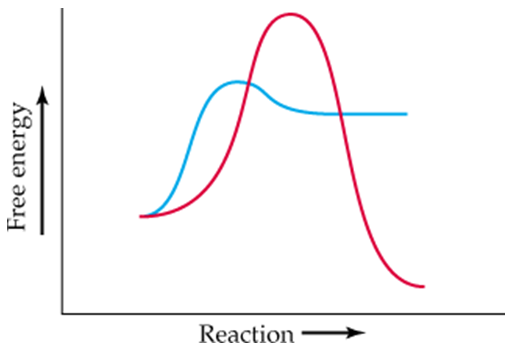
Two curves are shown in the following energy diagram:
b. Which curve represents the spontaneous reaction, and which the nonspontaneous?
문제 22a
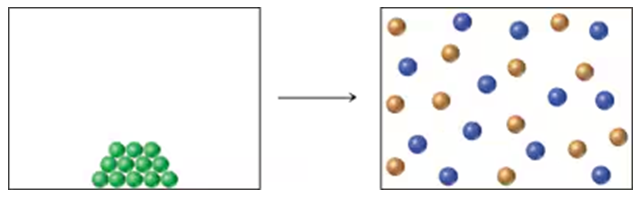
The following diagram portrays a reaction of the type A(s) → B(g) + C(g), where the different-colored spheres represent different molecular structures. Assume that the reaction has ∆H = +9.1 kcal/mol (+38.1 kJ/mol).
a. What is the sign of ∆S for the reaction?
문제 22b
The following diagram portrays a reaction of the type A(s) → B(g) + C(g), where the different-colored spheres represent different molecular structures. Assume that the reaction has ∆H = +9.1 kcal/mol (+38.1 kJ/mol).
b. Is the reaction likely to be spontaneous at all temperatures, nonspontaneous at all temperatures, or spontaneous at some but nonspontaneous at others?
문제 23
Is the total enthalpy (H) of the reactants for an endothermic reaction greater than or less than the total enthalpy of the products?
문제 25a
The vaporization of Br2 from the liquid to the gas state requires 7.4 kcal/mol (31.0 kJ/mol).
a. What is the sign of ∆H for this process? Write a reaction showing heat as a product or reactant.
문제 25c
The vaporization of Br2 from the liquid to the gas state requires 7.4 kcal/mol (31.0 kJ/mol).
c. How many kilojoules are needed to evaporate 82 g of Br2?
- Converting liquid water to solid ice releases 1.44 kcal/mol (6.02 kJ/mol). How many kilocalories are released by freezing 32 g of H2O?
문제 26
문제 27b
Acetylene (H–C≡C–H) is the fuel used in welding torches.
b. Estimate ∆H for this reaction (in kJ/mol) using the bond energies listed in Table 7.1.
문제 28b
Nitrogen in air reacts at high temperatures to form NO2 according to the following reaction: N2 + 2 O2 → 2 NO2
b. Estimate ∆H for this reaction (in kcal and kJ) using the bond energies from Table 7.1.
문제 29a
Glucose, also known as "blood sugar" when measured in blood, has the formula C6H12O6.
a. Write the equation for the combustion of glucose with O2 to give CO2 and H2O.
문제 29c
Glucose, also known as "blood sugar" when measured in blood, has the formula C6H12O6.
c. What is the minimum amount of energy (in kJ) a plant must absorb to produce 15.0 g of glucose?
문제 31
Which of the following processes results in an increase in entropy of the system?
a. A drop of ink spreading out when it is placed in water
b. Steam condensing into drops on windows
c. Constructing a building from loose bricks
문제 32a
For each of the following processes, specify whether entropy increases or decreases. Explain each of your answers.
a. Assembling a jigsaw puzzle
문제 33
What two factors affect the spontaneity of a reaction?
문제 34
What is the difference between an exothermic reaction and an exergonic reaction?
문제 36
Under what conditions might a reaction be endothermic but exergonic? Explain.