Ch.11 Nuclear Chemistry
McMurry - Fundamentals of General, Organic, and Biological Chemistry 8th Edition
McMurry8th EditionFundamentals of General, Organic, and Biological ChemistryISBN: 9780134015187당신이 사용하는 게 아니라요?교과서 변경
11장, 문제 26

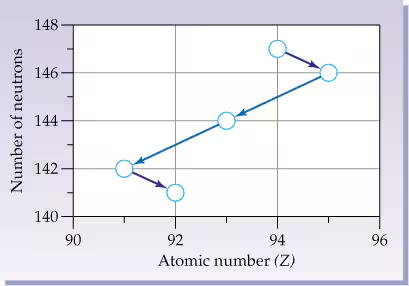
Identify and write the symbol for each of the five nuclides in the decay series shown in Problem 11.25.

검증된 단계별 안내
1
Step 1: Understand the concept of a decay series. A decay series is a sequence of radioactive decays where a parent nuclide undergoes decay to form a daughter nuclide, which may itself be radioactive and decay further. This process continues until a stable nuclide is formed.
Step 2: Review the type of decay processes involved in the series. Common types of decay include alpha decay (loss of an alpha particle, which is a helium nucleus, reducing the atomic number by 2 and the mass number by 4) and beta decay (conversion of a neutron to a proton or vice versa, changing the atomic number by ±1 without altering the mass number).
Step 3: For each step in the decay series, identify the parent nuclide and determine the daughter nuclide based on the type of decay. Use the periodic table to find the new element corresponding to the updated atomic number.
Step 4: Write the symbol for each nuclide in the series. The symbol for a nuclide is written as \( ^{A}_{Z}X \), where \( A \) is the mass number, \( Z \) is the atomic number, and \( X \) is the chemical symbol of the element.
Step 5: Repeat the process for all five nuclides in the decay series, ensuring that each step follows logically from the previous one. Verify the correctness of each nuclide by checking the conservation of mass number and atomic number in each decay process.

비슷한 문제에 대한 검증된 영상 답변:

이 영상 해법은 위 문제에 도움이 된다고 튜터들이 추천한 것입니다.
영상 길이:
3m
도움이 되었나요?

주요 개념

질문에 올바르게 답하기 위해 반드시 이해해야 하는 핵심 개념들은 다음과 같습니다.

Nuclide

A nuclide is a distinct nuclear species characterized by its number of protons and neutrons. Each nuclide is represented by a chemical symbol that includes the element's symbol, the atomic number (number of protons), and the mass number (total number of protons and neutrons). Understanding nuclides is essential for identifying elements in decay series.

Decay Series

A decay series is a sequence of nuclear reactions in which an unstable nuclide transforms into a series of other nuclides until a stable nuclide is formed. Each step in the series involves the emission of radiation, such as alpha or beta particles, and results in the formation of new nuclides. Recognizing the order and types of decay is crucial for determining the symbols of the nuclides involved.
추천 영상:
가이드 코스
01:02
Characteristics of Beta Particles Example

Symbol Representation

The symbol representation of a nuclide includes the element's chemical symbol, the mass number as a superscript, and the atomic number as a subscript. For example, the symbol for carbon-14 is written as ¹⁴C, where 14 is the mass number and C is the chemical symbol for carbon. Properly writing these symbols is vital for accurately identifying and communicating about nuclides in a decay series.
추천 영상:
가이드 코스
04:01
Periodic Table: Symbols Concept