Ch.2 Atoms and the Periodic Table
McMurry - Fundamentals of General, Organic, and Biological Chemistry 8th Edition
McMurry8th EditionFundamentals of General, Organic, and Biological ChemistryISBN: 9780134015187당신이 사용하는 게 아니라요?교과서 변경
2장, 문제 65

What is the total number of orbitals in the third shell? The fourth shell?

검증된 단계별 안내
1
Understand that the number of orbitals in a shell is determined by the principal quantum number (n). Each shell corresponds to a specific value of n (e.g., n = 3 for the third shell, n = 4 for the fourth shell).
Recall that the number of subshells in a shell is equal to n. For example, the third shell (n = 3) has three subshells: 3s, 3p, and 3d, while the fourth shell (n = 4) has four subshells: 4s, 4p, 4d, and 4f.
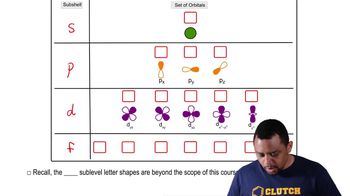
Each subshell contains a specific number of orbitals. The s subshell has 1 orbital, the p subshell has 3 orbitals, the d subshell has 5 orbitals, and the f subshell has 7 orbitals.
Calculate the total number of orbitals in the third shell by summing the orbitals in its subshells: 1 (from 3s) + 3 (from 3p) + 5 (from 3d). Similarly, calculate the total number of orbitals in the fourth shell by summing the orbitals in its subshells: 1 (from 4s) + 3 (from 4p) + 5 (from 4d) + 7 (from 4f).
Conclude that the total number of orbitals in a shell is given by the formula \( n^2 \), where n is the principal quantum number. For the third shell (n = 3), the total number of orbitals is \( 3^2 \). For the fourth shell (n = 4), the total number of orbitals is \( 4^2 \).

비슷한 문제에 대한 검증된 영상 답변:

이 영상 해법은 위 문제에 도움이 된다고 튜터들이 추천한 것입니다.
영상 길이:
3m
도움이 되었나요?

주요 개념

질문에 올바르게 답하기 위해 반드시 이해해야 하는 핵심 개념들은 다음과 같습니다.

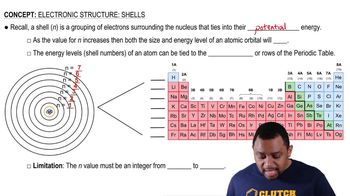
Electron Shells

Electron shells are the regions around an atom's nucleus where electrons are likely to be found. Each shell is associated with a principal quantum number (n), which indicates its energy level and distance from the nucleus. The third shell corresponds to n=3, while the fourth shell corresponds to n=4.
추천 영상:
가이드 코스
02:29
Electronic Structure: Shells Concept 1

Orbitals

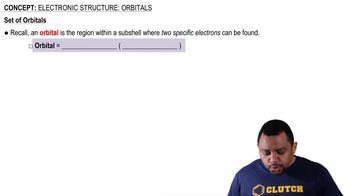
Orbitals are specific regions within electron shells where electrons are likely to be located. Each shell can contain multiple orbitals, which are categorized into types (s, p, d, f) based on their shape and energy. The number of orbitals in a shell is determined by the formula n^2, where n is the principal quantum number.
추천 영상:
가이드 코스
02:57
Electronic Structure: Orbitals Concept 3

Calculating Orbitals in Shells

To find the total number of orbitals in a given shell, you apply the formula n^2. For the third shell (n=3), the total number of orbitals is 3^2 = 9. For the fourth shell (n=4), the total number of orbitals is 4^2 = 16. This calculation is essential for understanding electron configuration and chemical bonding.
추천 영상:
가이드 코스
00:38
Electronic Structure: Orbitals Concept 2