Ch.3 Ionic Compounds
McMurry - Fundamentals of General, Organic, and Biological Chemistry 8th Edition
McMurry8th EditionFundamentals of General, Organic, and Biological ChemistryISBN: 9780134015187당신이 사용하는 게 아니라요?교과서 변경
3장, 문제 52

Which of the following ions are likely to form? Explain.
a. Li2+
b. K-
c. Mn3+
d. Zn4+
e. Ne+

검증된 단계별 안내
1
Step 1: Understand the stability of ions based on their electron configurations. Ions form when atoms gain or lose electrons to achieve a more stable electron configuration, often resembling the nearest noble gas configuration.
Step 2: Analyze Li^2+. Lithium (Li) has an atomic number of 3, meaning it has 3 electrons. Removing 2 electrons would leave only 1 electron, which is highly unstable. Therefore, Li^2+ is unlikely to form.
Step 3: Analyze K-. Potassium (K) has an atomic number of 19, meaning it has 19 electrons. Adding an extra electron would result in 20 electrons, which would disrupt its stable electron configuration (similar to argon). Potassium typically loses one electron to form K+, so K- is unlikely to form.
Step 4: Analyze Mn^3+. Manganese (Mn) has an atomic number of 25. It can lose electrons to form stable ions, and Mn^3+ is a common oxidation state for manganese in compounds. Therefore, Mn^3+ is likely to form.
Step 5: Analyze Zn^4+ and Ne+. Zinc (Zn) has an atomic number of 30, and losing 4 electrons would require disrupting a stable d10 configuration, making Zn^4+ highly unlikely. Neon (Ne) is a noble gas with a stable electron configuration, and removing an electron to form Ne+ would disrupt this stability, making Ne+ unlikely to form.

비슷한 문제에 대한 검증된 영상 답변:

이 영상 해법은 위 문제에 도움이 된다고 튜터들이 추천한 것입니다.
영상 길이:
9m
도움이 되었나요?

주요 개념

질문에 올바르게 답하기 위해 반드시 이해해야 하는 핵심 개념들은 다음과 같습니다.

Ionic Charge and Stability

Ionic charge refers to the electrical charge an atom acquires when it loses or gains electrons. Ions with a stable electron configuration, typically resembling that of noble gases, are more likely to form. For example, elements tend to lose or gain electrons to achieve a full outer shell, which influences their likelihood of forming specific ions.
추천 영상:
가이드 코스
02:33
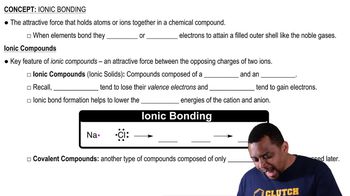
Ionic Bonding Concept 1

Common Oxidation States

Oxidation states indicate the degree of oxidation of an atom in a compound, reflecting the number of electrons lost or gained. Certain elements have well-known oxidation states; for instance, transition metals like manganese can exhibit multiple oxidation states, such as +3. Understanding these states helps predict which ions are likely to form based on the element's position in the periodic table.
추천 영상:
가이드 코스
01:01
States of Matter Example 1

Noble Gas Configuration

Noble gas configuration refers to the electron arrangement of noble gases, which are chemically inert due to their full valence shells. Atoms tend to form ions that achieve this stable configuration. For example, Ne+ suggests a loss of an electron from neon, which is unlikely since neon already has a full outer shell, making it a poor candidate for ion formation.
추천 영상:
가이드 코스
01:08
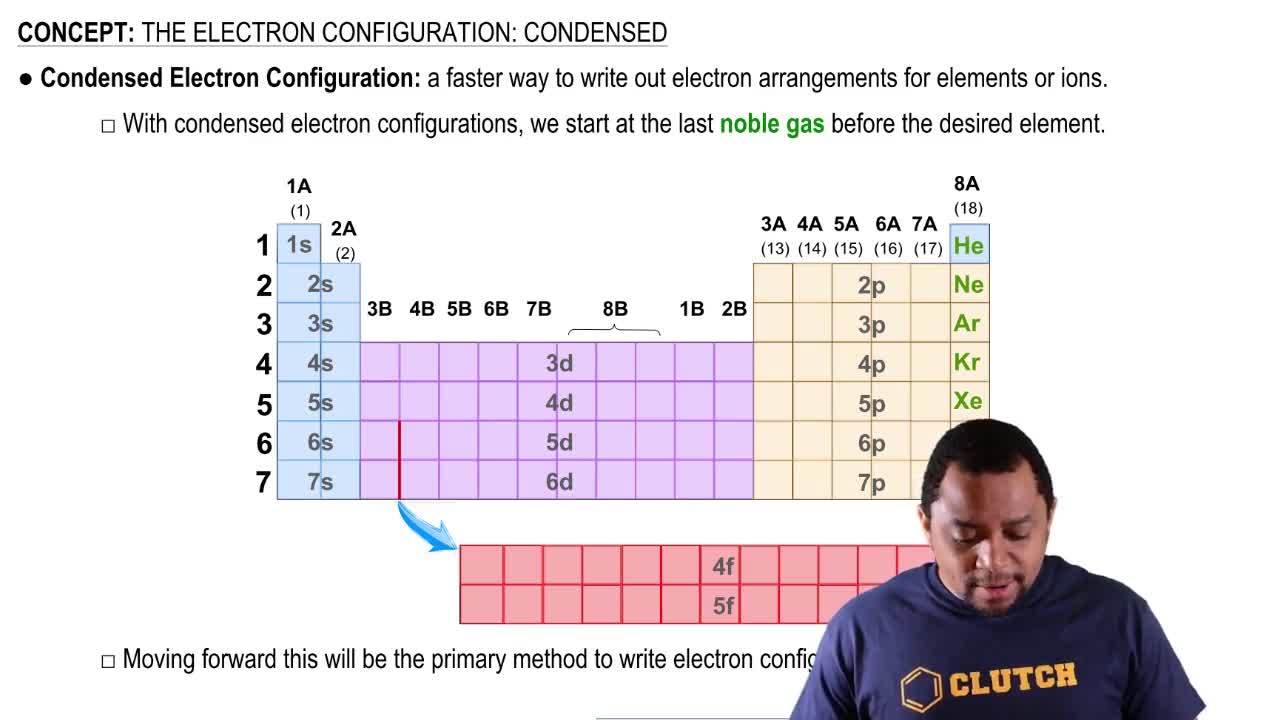
The Electron Configuration: Condensed