Ch.5 Classification & Balancing of Chemical Reactions
McMurry - Fundamentals of General, Organic, and Biological Chemistry 8th Edition
McMurry8th EditionFundamentals of General, Organic, and Biological ChemistryISBN: 9780134015187당신이 사용하는 게 아니라요?교과서 변경
5장, 문제 20

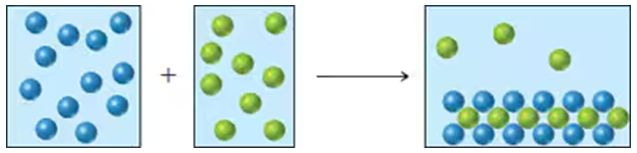
An aqueous solution of a cation (represented as blue spheres in the diagram) is allowed to mix with a solution of an anion (represented as green spheres) and the following result is obtained:

Which combinations of cation and anion, chosen from the following lists, are compatible with the observed results? Explain.
Cations: Na+, Ca2+, Ag+, Ni2+
Anions: Cl, CO23–, CrO42–, NO3

검증된 단계별 안내
1
Step 1: Analyze the image provided. The diagram shows two solutions being mixed: one containing green spheres (representing anions) and the other containing red spheres (representing cations). After mixing, a solid precipitate forms at the bottom of the container, indicating that a chemical reaction has occurred and a precipitate has formed.
Step 2: Understand the concept of solubility rules. Precipitation occurs when the product of a reaction between a cation and an anion is insoluble in water. Use solubility rules to determine which combinations of cations and anions can form an insoluble compound.
Step 3: Evaluate the possible combinations of cations and anions provided in the problem. The cations are Na+, Ca2+, Ag+, and Ni2+, and the anions are Cl−, CO3^2−, CrO4^2−, and NO3−. Cross-reference these ions with solubility rules to identify which combinations produce an insoluble compound.
Step 4: Apply solubility rules to each combination. For example, Ag+ often forms insoluble compounds with Cl− (AgCl is insoluble), while Na+ typically forms soluble compounds with all the anions listed. Similarly, Ca2+ can form insoluble compounds with CO3^2− (CaCO3 is insoluble). Continue this process for all combinations.
Step 5: Based on the solubility rules and the observed precipitation in the diagram, identify the specific cation and anion pair that is compatible with the results. Ensure the pair corresponds to an insoluble compound forming a precipitate, as shown in the image.

비슷한 문제에 대한 검증된 영상 답변:

이 영상 해법은 위 문제에 도움이 된다고 튜터들이 추천한 것입니다.
영상 길이:
3m
도움이 되었나요?

주요 개념

질문에 올바르게 답하기 위해 반드시 이해해야 하는 핵심 개념들은 다음과 같습니다.

Ionic Compounds

Ionic compounds are formed when cations (positively charged ions) and anions (negatively charged ions) combine due to electrostatic forces. The stability of these compounds depends on the charge and size of the ions involved. In the context of the question, understanding how different cations and anions interact is crucial for predicting which combinations will form stable ionic compounds.
추천 영상:
가이드 코스
02:11
Naming Ionic Compounds

Solubility Rules

Solubility rules are guidelines that help predict whether an ionic compound will dissolve in water. Certain combinations of cations and anions are known to be soluble or insoluble based on these rules. For example, compounds containing Na+ or NO3− are generally soluble, while others may form precipitates. This concept is essential for determining the compatibility of the given cations and anions.
추천 영상:
가이드 코스
00:28
Solubility Rules

Precipitation Reactions

Precipitation reactions occur when two solutions containing soluble salts are mixed, resulting in the formation of an insoluble compound that precipitates out of solution. The image illustrates this process, showing layered spheres that suggest a solid formation. Identifying which combinations of cations and anions lead to precipitation is key to answering the question effectively.
추천 영상:
가이드 코스
1:30
Alcohol Reactions: Dehydration Reactions Concept 1