Ch.6 Chemical Reactions: Mole and Mass Relationships
McMurry - Fundamentals of General, Organic, and Biological Chemistry 8th Edition
McMurry8th EditionFundamentals of General, Organic, and Biological ChemistryISBN: 9780134015187당신이 사용하는 게 아니라요?교과서 변경
6장, 문제 13

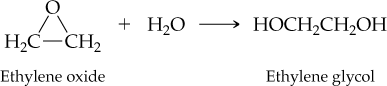
The reaction of ethylene oxide with water to give ethylene glycol (automobile antifreeze) occurs in 96.0% actual yield. How many grams of ethylene glycol are formed by reaction of 35.0 g of ethylene oxide? (For ethylene oxide, MW = 44.0 amu; for ethylene glycol, MW = 62.0 amu.)
Chemical reaction diagram showing ethylene oxide reacting with water to form ethylene glycol, with yield information.

검증된 단계별 안내
1
Step 1: Write the balanced chemical equation for the reaction. Ethylene oxide (C₂H₄O) reacts with water (H₂O) to form ethylene glycol (C₂H₆O₂). The balanced equation is: C₂H₄O + H₂O → C₂H₆O₂.
Step 2: Calculate the number of moles of ethylene oxide (C₂H₄O) using its molecular weight. Use the formula: \( \text{moles} = \frac{\text{mass}}{\text{molecular weight}} \). Substitute the given mass of ethylene oxide (35.0 g) and its molecular weight (44.0 g/mol).
Step 3: Use the stoichiometry of the reaction to determine the moles of ethylene glycol (C₂H₆O₂) produced. From the balanced equation, the molar ratio of ethylene oxide to ethylene glycol is 1:1. Therefore, the moles of ethylene glycol formed will be equal to the moles of ethylene oxide reacted.
Step 4: Convert the moles of ethylene glycol to grams using its molecular weight. Use the formula: \( \text{mass} = \text{moles} \times \text{molecular weight} \). Substitute the moles of ethylene glycol and its molecular weight (62.0 g/mol).
Step 5: Account for the actual yield of the reaction. Multiply the theoretical mass of ethylene glycol (calculated in Step 4) by the actual yield (96.0%) expressed as a decimal (0.960). This will give the actual mass of ethylene glycol produced.

비슷한 문제에 대한 검증된 영상 답변:

이 영상 해법은 위 문제에 도움이 된다고 튜터들이 추천한 것입니다.
영상 길이:
5m

주요 개념

질문에 올바르게 답하기 위해 반드시 이해해야 하는 핵심 개념들은 다음과 같습니다.

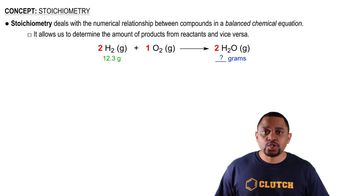
Stoichiometry

Stoichiometry is the calculation of reactants and products in chemical reactions based on the balanced chemical equation. It allows us to determine the amount of product formed from a given amount of reactant by using molar ratios derived from the coefficients in the balanced equation.
추천 영상:

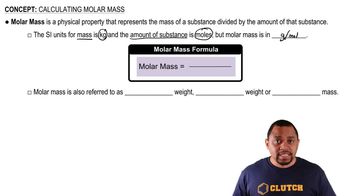
Molar Mass

Molar mass is the mass of one mole of a substance, expressed in grams per mole (g/mol). It is essential for converting between grams and moles, enabling the calculation of how many moles of a substance are present in a given mass, which is crucial for stoichiometric calculations.
추천 영상:
가이드 코스
01:10
Calculating Molar Mass

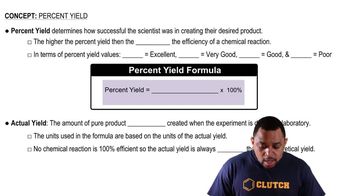
Percent Yield

Percent yield is a measure of the efficiency of a chemical reaction, calculated as the ratio of the actual yield to the theoretical yield, multiplied by 100. It indicates how much of the expected product was actually obtained, which is important for assessing the success of a reaction and for practical applications in chemistry.
추천 영상: