Ch.7 Chemical Reactions: Energy, Rate and Equilibrium
McMurry - Fundamentals of General, Organic, and Biological Chemistry 8th Edition
McMurry8th EditionFundamentals of General, Organic, and Biological ChemistryISBN: 9780134015187당신이 사용하는 게 아니라요?교과서 변경
7장, 문제 14b

The following diagrams represent two similar reactions that have achieved equilibrium:
<IMAGE>
b. Calculate the value for the equilibrium constant for each reaction.

검증된 단계별 안내
1
Step 1: Identify the chemical equation provided in the diagram. The reaction is A₂ + 3 B ⇌ 2 C₂, where A₂ represents blue molecules, B represents green molecules, and C₂ represents orange molecules.
Step 2: Count the number of molecules for each species in the diagram. For A₂, count the blue pairs; for B, count the green single molecules; and for C₂, count the orange pairs.
Step 3: Write the expression for the equilibrium constant (K_eq) based on the balanced chemical equation. The formula is: K_eq = ([C₂]^2) / ([A₂] × [B]^3), where the concentrations are proportional to the number of molecules.
Step 4: Substitute the counts of molecules into the equilibrium constant expression. Use the counts from Step 2 to represent the concentrations of A₂, B, and C₂.
Step 5: Simplify the expression to calculate the equilibrium constant. Ensure that the values are plugged in correctly and follow the rules of exponents and division.

비슷한 문제에 대한 검증된 영상 답변:

이 영상 해법은 위 문제에 도움이 된다고 튜터들이 추천한 것입니다.
영상 길이:
1m
도움이 되었나요?

주요 개념

질문에 올바르게 답하기 위해 반드시 이해해야 하는 핵심 개념들은 다음과 같습니다.

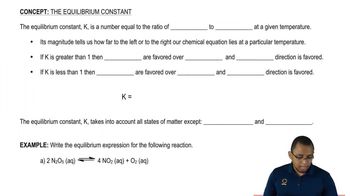
Equilibrium Constant (K)

The equilibrium constant (K) is a numerical value that expresses the ratio of the concentrations of products to reactants at equilibrium for a given chemical reaction. It is calculated using the formula K = [C]^c / ([A]^a * [B]^b), where [C], [A], and [B] are the molar concentrations of the products and reactants, and a, b, and c are their respective coefficients in the balanced equation.
추천 영상:
가이드 코스
02:50
The Equilibrium Constant Concept 1

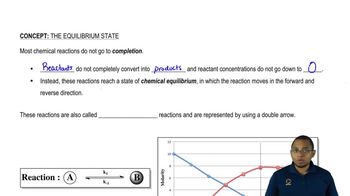
Chemical Equilibrium

Chemical equilibrium occurs when the rates of the forward and reverse reactions are equal, resulting in constant concentrations of reactants and products over time. At this point, the system is in a state of balance, and any changes in concentration, temperature, or pressure can shift the equilibrium position according to Le Chatelier's principle.
추천 영상:
가이드 코스
03:42
Chemical Equilibrium Concept 1

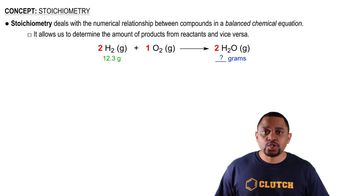
Stoichiometry

Stoichiometry is the calculation of reactants and products in chemical reactions based on the balanced equation. It involves using the coefficients of the balanced equation to determine the proportions of substances involved, which is essential for calculating the equilibrium constant and understanding the relationships between different species in a reaction.
추천 영상: