Ch.7 Chemical Reactions: Energy, Rate and Equilibrium
McMurry - Fundamentals of General, Organic, and Biological Chemistry 8th Edition
McMurry8th EditionFundamentals of General, Organic, and Biological ChemistryISBN: 9780134015187당신이 사용하는 게 아니라요?교과서 변경
7장, 문제 45

What is a catalyst, and what effect does it have on the activation energy of a reaction?

검증된 단계별 안내
1
A catalyst is a substance that increases the rate of a chemical reaction without being consumed in the reaction itself. It participates in the reaction but is regenerated at the end.
The role of a catalyst is to provide an alternative reaction pathway with a lower activation energy compared to the uncatalyzed reaction.
Activation energy is the minimum energy required for reactants to collide and form products. A lower activation energy means that more reactant molecules have sufficient energy to overcome this barrier, leading to a faster reaction rate.
The catalyst achieves this by stabilizing the transition state or forming intermediate species that require less energy to proceed to the products.
It is important to note that while a catalyst speeds up the reaction, it does not alter the equilibrium position or the overall energy change (ΔH) of the reaction.

비슷한 문제에 대한 검증된 영상 답변:

이 영상 해법은 위 문제에 도움이 된다고 튜터들이 추천한 것입니다.
영상 길이:
1m
도움이 되었나요?

주요 개념

질문에 올바르게 답하기 위해 반드시 이해해야 하는 핵심 개념들은 다음과 같습니다.

Catalyst

A catalyst is a substance that increases the rate of a chemical reaction without being consumed in the process. It achieves this by providing an alternative reaction pathway with a lower activation energy, allowing the reaction to proceed more quickly. Catalysts are crucial in various industrial processes and biological systems, where they facilitate reactions that would otherwise occur too slowly.
추천 영상:
가이드 코스
1:17
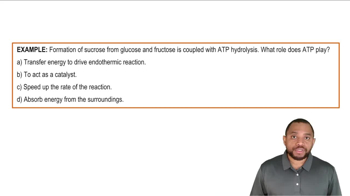
Coupled Reactions Example 3

Activation Energy

Activation energy is the minimum energy required for a chemical reaction to occur. It represents the energy barrier that reactants must overcome to transform into products. By lowering the activation energy, catalysts enable more reactant molecules to have sufficient energy to react, thereby increasing the reaction rate and efficiency.
추천 영상:
가이드 코스
1:06
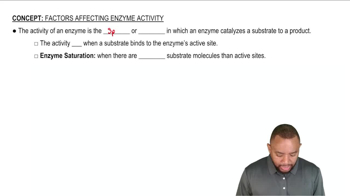
Factors Affecting Enzyme Activity Concept 1

Reaction Mechanism

A reaction mechanism is a detailed description of the step-by-step process by which reactants are converted into products in a chemical reaction. It outlines the individual steps, intermediates, and transition states involved. Understanding the reaction mechanism is essential for comprehending how catalysts influence the reaction pathway and the overall energy changes during the reaction.
추천 영상:
가이드 코스
1:30
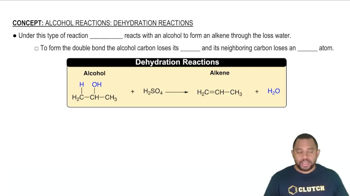
Alcohol Reactions: Dehydration Reactions Concept 1