Ch.7 Chemical Reactions: Energy, Rate and Equilibrium
McMurry - Fundamentals of General, Organic, and Biological Chemistry 8th Edition
McMurry8th EditionFundamentals of General, Organic, and Biological ChemistryISBN: 9780134015187당신이 사용하는 게 아니라요?교과서 변경
7장, 문제 49

What is meant by the term 'chemical equilibrium'? Must amounts of reactants and products be equal at equilibrium?

검증된 단계별 안내
1
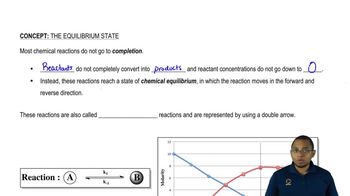
Chemical equilibrium refers to the state in a chemical reaction where the rate of the forward reaction (reactants converting to products) equals the rate of the reverse reaction (products converting back to reactants). At this point, the concentrations of reactants and products remain constant over time, though they are not necessarily equal.
Understand that equilibrium is a dynamic process, meaning that both the forward and reverse reactions are still occurring, but they happen at the same rate, so there is no net change in the concentrations of reactants and products.
No, the amounts of reactants and products do not have to be equal at equilibrium. The relative concentrations depend on the equilibrium constant (K), which is determined by the specific reaction and its conditions (e.g., temperature).
The equilibrium constant (K) is expressed as the ratio of the concentrations of products to reactants, each raised to the power of their respective coefficients in the balanced chemical equation. For example, for a reaction \( aA + bB \leftrightarrow cC + dD \), the equilibrium constant is \( K = \frac{[C]^c[D]^d}{[A]^a[B]^b} \).
In summary, chemical equilibrium is about the balance of reaction rates, not the equality of reactant and product amounts. The specific ratio of concentrations at equilibrium is determined by the equilibrium constant for the reaction.

비슷한 문제에 대한 검증된 영상 답변:

이 영상 해법은 위 문제에 도움이 된다고 튜터들이 추천한 것입니다.
영상 길이:
1m
도움이 되었나요?

주요 개념

질문에 올바르게 답하기 위해 반드시 이해해야 하는 핵심 개념들은 다음과 같습니다.

Chemical Equilibrium

Chemical equilibrium refers to a state in a reversible chemical reaction where the rates of the forward and reverse reactions are equal, resulting in constant concentrations of reactants and products over time. This dynamic balance means that while the reaction continues to occur, there is no net change in the amounts of substances involved.
추천 영상:
가이드 코스
03:42
Chemical Equilibrium Concept 1

Dynamic Nature of Equilibrium

Equilibrium is not a static condition; rather, it is dynamic, meaning that the reactants and products are constantly being converted into one another. This ongoing process allows for the concentrations of reactants and products to remain constant, even though individual molecules are still reacting.
추천 영상:
가이드 코스
01:26
Nature of Energy

Concentration Ratios

At equilibrium, the concentrations of reactants and products are related by the equilibrium constant (K), which reflects the ratio of product concentrations to reactant concentrations raised to the power of their coefficients in the balanced equation. This means that the amounts of reactants and products do not have to be equal; rather, they depend on the specific reaction and its conditions.
추천 영상:
가이드 코스
00:52
Percent Concentrations Concept 1