
Ch.9 Solutions
McMurry - Fundamentals of General, Organic, and Biological Chemistry 8th Edition
McMurry8th EditionFundamentals of General, Organic, and Biological ChemistryISBN: 9780134015187당신이 사용하는 게 아니라요?교과서 변경
9장, 문제 95a

Many compounds are only partially dissociated into ions in aqueous solution. Trichloroacetic acid (CCl3CO2H), for instance, is partially dissociated in water according to the equation
CCl3CO2H(aq) → H+(aq) + CCl3CO2⁻ aq)
For a solution prepared by dissolving 1.00 mol of trichloroacetic acid in 1.00 kg of water, 36.0% of the trichloroacetic acid dissociates to form H+ and CCl3CO2⁻ ions.
a. What is the total concentration of dissolved ions and molecules in 1 kg of water?

검증된 단계별 안내
1
Step 1: Understand the dissociation process. Trichloroacetic acid (CCl₃CO₂H) is a weak acid that partially dissociates in water. The dissociation reaction is: CCl₃CO₂H (aq) → H⁺ (aq) + CCl₃CO₂⁻ (aq). This means that for every mole of CCl₃CO₂H that dissociates, 1 mole of H⁺ and 1 mole of CCl₃CO₂⁻ are produced.
Step 2: Calculate the number of moles of trichloroacetic acid that dissociate. Since 36.0% of the acid dissociates, multiply the initial moles of CCl₃CO₂H (1.00 mol) by 0.36 to find the moles of dissociated acid.
Step 3: Determine the moles of ions produced. For every mole of dissociated CCl₃CO₂H, 1 mole of H⁺ and 1 mole of CCl₃CO₂⁻ are formed. Therefore, the moles of H⁺ and CCl₃CO₂⁻ ions will each equal the moles of dissociated CCl₃CO₂H. Add these two values together to find the total moles of ions produced.
Step 4: Calculate the moles of undissociated CCl₃CO₂H remaining. Subtract the moles of dissociated CCl₃CO₂H (calculated in Step 2) from the initial moles of CCl₃CO₂H (1.00 mol). This gives the moles of undissociated molecules.
Step 5: Add the moles of undissociated CCl₃CO₂H to the total moles of ions (from Step 3) to find the total concentration of dissolved species (ions and molecules) in the solution. Since the solution is prepared in 1.00 kg of water, the total moles calculated represent the total concentration in mol/kg.

비슷한 문제에 대한 검증된 영상 답변:

이 영상 해법은 위 문제에 도움이 된다고 튜터들이 추천한 것입니다.
영상 길이:
4m
도움이 되었나요?

주요 개념

질문에 올바르게 답하기 위해 반드시 이해해야 하는 핵심 개념들은 다음과 같습니다.

Dissociation of Acids

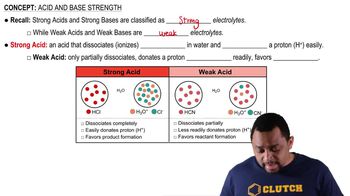
Dissociation refers to the process by which an acid separates into its constituent ions when dissolved in water. For weak acids like trichloroacetic acid, this process is not complete, meaning only a fraction of the acid molecules release protons (H⁺) and form anions. Understanding the degree of dissociation is crucial for calculating the concentrations of ions in solution.
추천 영상:
가이드 코스
02:06
Acid and Base Strength Concept 1

Concentration Calculations

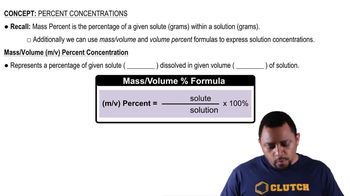
Concentration is a measure of the amount of a substance in a given volume of solution. In this context, it involves calculating the total concentration of all species present, including both the undissociated acid and the ions produced from dissociation. This requires using the initial amount of acid and the percentage that dissociates to find the final concentrations.
추천 영상:
가이드 코스
00:52
Percent Concentrations Concept 1

Molarity and Total Ion Concentration

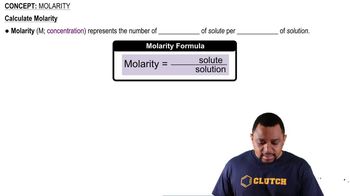
Molarity is defined as the number of moles of solute per liter of solution. To find the total concentration of dissolved ions and molecules, one must consider both the dissociated ions and the undissociated acid. This involves summing the concentrations of H⁺ ions, CCl₃CO₂⁻ ions, and the remaining undissociated trichloroacetic acid in the solution.
추천 영상:
관련 실천
교과서 질문

Hyperbaric chambers, which provide high pressures (up to 6 atm) of either air or pure oxygen, are used to treat a variety of conditions, ranging from decompression sickness in deep-sea divers to carbon monoxide poisoning. Look up the solubility of O2, N2, CO, and CO2 in water at standard temperature and pressure (1 atm, 25 °C).

a. Explain the trends in relative solubility for these gases.

2176
views
교과서 질문

How many milliliters of 0.150 M BaCl2 are needed to react completely with 35.0 mL of 0.200 M Na2SO4? How many grams of BaSO4 will be formed?

2335
views
교과서 질문

Ammonia, NH3, is very soluble in water (51.8 g/L at 20 °C and 760 mmHg).

a. Show how NH3 can hydrogen bond to water.

2412
views
교과서 질문

Many compounds are only partially dissociated into ions in aqueous solution. Trichloroacetic acid (CCl3CO2H), for instance, is partially dissociated in water according to the equation

CCl3CO2H(aq) → H+(aq) + CCl3CO2⁻ aq)

For a solution prepared by dissolving 1.00 mol of trichloroacetic acid in 1.00 kg of water, 36.0% of the trichloroacetic acid dissociates to form H+ and CCl3CO2⁻ ions.

b. What is the freezing point of this solution? (The freezing point of 1 kg of water is lowered 1.86 °C for each mole of solute particles.)

1754
views
교과서 질문

Hyperbaric chambers, which provide high pressures (up to 6 atm) of either air or pure oxygen, are used to treat a variety of conditions, ranging from decompression sickness in deep-sea divers to carbon monoxide poisoning. Look up the solubility of O2, N2, CO, and CO2 in water at standard temperature and pressure (1 atm, 25 °C).

b. Explain how elevated pressures in a hyperbaric chamber be used to treat decompression sickness (excess N2 in blood) and carbon monoxide poisoning.

2891
views
교과서 질문

Cobalt(II) chloride, a blue solid, can absorb water from the air to form cobalt(II) chloride hexahydrate, a pink solid. The equilibrium is so sensitive to moisture in the air that CoCl2 is used as a humidity indicator.

a. Write a balanced equation for the equilibrium. Be sure to include water as a reactant to produce the hexahydrate.

2453
views