Ch.13 Alkenes, Alkynes, and Aromatic Compounds
McMurry - Fundamentals of General, Organic, and Biological Chemistry 8th Edition
McMurry8th EditionFundamentals of General, Organic, and Biological ChemistryISBN: 9780134015187당신이 사용하는 게 아니라요?교과서 변경
13장, 문제 67

Aromatic compounds do not normally react with hydrogen in the presence of a palladium catalyst but will if very high pressures (200 atm) and high temperatures are used. Under these conditions, toluene adds three molecules of H2 to give an alkane addition product. What is a likely structure for the product?

검증된 단계별 안내
1
Identify the structure of toluene. Toluene is an aromatic compound consisting of a benzene ring (C6H6) with a methyl group (-CH3) attached to one of the carbons in the ring.
Understand the reaction conditions. Aromatic compounds like toluene are typically stable and do not react with hydrogen under normal conditions. However, under high pressure (200 atm) and high temperature, the aromaticity of the benzene ring can be disrupted, allowing hydrogenation to occur.
Determine the hydrogenation process. Hydrogenation involves the addition of hydrogen (H2) molecules to the double bonds in the benzene ring. Since the benzene ring has three double bonds, three molecules of H2 will be added, converting the benzene ring into a fully saturated cyclohexane ring (C6H12).
Account for the methyl group. The methyl group (-CH3) attached to the benzene ring remains unchanged during the hydrogenation process. It will still be attached to one of the carbons in the now-saturated cyclohexane ring.
Combine the results. The final product is a cyclohexane ring with a methyl group attached to one of its carbons. This compound is called methylcyclohexane.

비슷한 문제에 대한 검증된 영상 답변:

이 영상 해법은 위 문제에 도움이 된다고 튜터들이 추천한 것입니다.
도움이 되었나요?

주요 개념

질문에 올바르게 답하기 위해 반드시 이해해야 하는 핵심 개념들은 다음과 같습니다.

Aromatic Compounds

Aromatic compounds are a class of cyclic compounds characterized by their stable ring structure and delocalized pi electrons, which contribute to their unique chemical properties. They typically resist reactions that would disrupt this stability, such as hydrogenation, under normal conditions. Toluene, an aromatic compound, is a methyl-substituted benzene that can undergo hydrogenation under extreme conditions.
추천 영상:
가이드 코스
02:11
Naming Ionic Compounds

Hydrogenation

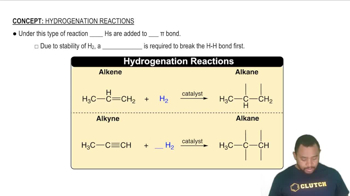
Hydrogenation is a chemical reaction that involves the addition of hydrogen (H2) to a compound, often in the presence of a catalyst like palladium. In the case of aromatic compounds, hydrogenation usually requires high pressures and temperatures to overcome the stability of the aromatic system. The reaction converts the aromatic compound into a saturated alkane by adding hydrogen across the double bonds.
추천 영상:
가이드 코스
1:22
Hydrogenation Reactions Concept 1

Reaction Conditions

The reaction conditions, such as temperature and pressure, play a crucial role in determining the outcome of chemical reactions. In this scenario, very high pressures (200 atm) and high temperatures are necessary to facilitate the hydrogenation of toluene, allowing it to add multiple hydrogen molecules. These extreme conditions enable the breaking of the aromatic stability, leading to the formation of a saturated alkane product.
추천 영상:
가이드 코스
1:13
Benzene Reactions Concept 1