Ch.13 Alkenes, Alkynes, and Aromatic Compounds
McMurry - Fundamentals of General, Organic, and Biological Chemistry 8th Edition
McMurry8th EditionFundamentals of General, Organic, and Biological ChemistryISBN: 9780134015187당신이 사용하는 게 아니라요?교과서 변경
13장, 문제 55

If bromocyclohexane were converted into cyclohexene, what kind of reaction would that be?

검증된 단계별 안내
1
Identify the starting material and the product: Bromocyclohexane is the starting material, and cyclohexene is the product.
Recognize the functional groups involved: Bromocyclohexane contains a bromine atom attached to a cyclohexane ring, while cyclohexene is a cyclohexane ring with a double bond.
Determine the type of reaction: The conversion involves the removal of a bromine atom and the formation of a double bond, which is characteristic of an elimination reaction.
Consider the mechanism: This is likely an E2 elimination reaction, where a base abstracts a proton adjacent to the carbon bearing the bromine, leading to the formation of a double bond and the expulsion of the bromide ion.
Summarize the reaction type: The conversion of bromocyclohexane to cyclohexene is an elimination reaction, specifically an E2 mechanism.

비슷한 문제에 대한 검증된 영상 답변:

이 영상 해법은 위 문제에 도움이 된다고 튜터들이 추천한 것입니다.
도움이 되었나요?

주요 개념

질문에 올바르게 답하기 위해 반드시 이해해야 하는 핵심 개념들은 다음과 같습니다.

Elimination Reaction

An elimination reaction is a type of chemical reaction where a molecule loses atoms or groups of atoms, resulting in the formation of a double bond or a ring structure. In the case of converting bromocyclohexane to cyclohexene, the reaction involves the removal of a bromine atom and a hydrogen atom, leading to the formation of a carbon-carbon double bond.
추천 영상:
가이드 코스
1:13
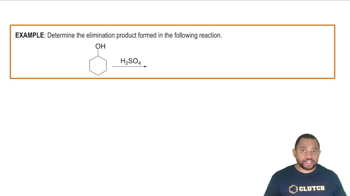
Alcohol Reactions Dehydration Reactions Example 1

Dehydrohalogenation

Dehydrohalogenation is a specific type of elimination reaction where a hydrogen halide (like HBr) is removed from a haloalkane. This process is crucial in the conversion of bromocyclohexane to cyclohexene, as it involves the elimination of bromine and a hydrogen atom, resulting in the formation of an alkene.
추천 영상:
가이드 코스
0:56
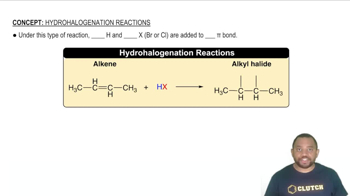
Hydrohalogenation Reaction Concept 1

Zaitsev's Rule

Zaitsev's Rule states that in elimination reactions, the more substituted alkene is typically the major product. This principle helps predict the outcome of the reaction when converting bromocyclohexane to cyclohexene, as the stability of the resulting alkene can influence the reaction pathway and product distribution.
추천 영상:
가이드 코스
1:24
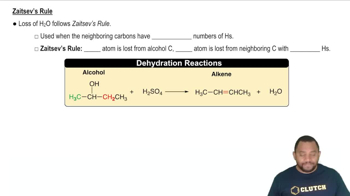
Zaitsev’s Rule Concept 2