Ch.13 Alkenes, Alkynes, and Aromatic Compounds
McMurry - Fundamentals of General, Organic, and Biological Chemistry 8th Edition
McMurry8th EditionFundamentals of General, Organic, and Biological ChemistryISBN: 9780134015187당신이 사용하는 게 아니라요?교과서 변경
13장, 문제 17

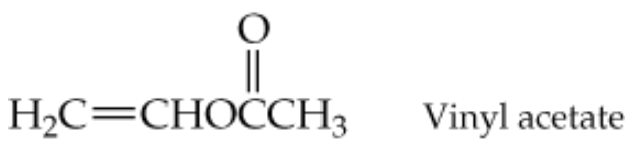
The structure of vinyl acetate is shown below (the partial structure H2C=CH-is known as a vinyl group). When polymerized it produces poly(vinyl acetate), a polymer used for the springy soles in running shoes. Draw the structure of the polymer obtained if three vinyl acetate units underwent polymerization.
Chemical structure of vinyl acetate, showing H2C=CH- and the label "Vinyl acetate" on the right.

검증된 단계별 안내
1
Understand the problem: Vinyl acetate is a monomer that contains a vinyl group (H₂C=CH-) and an acetate group (-OCOCH₃). During polymerization, the double bond in the vinyl group breaks, allowing the monomers to link together in a repeating chain.
Identify the repeating unit: The repeating unit in the polymer is derived from the vinyl acetate monomer. When the double bond in the vinyl group breaks, the monomer forms two single bonds that connect to adjacent monomers.
Visualize the polymerization process: In this case, three vinyl acetate units are polymerized. The double bonds in the vinyl groups of all three monomers break, and the monomers link together in a head-to-tail fashion, forming a chain.
Draw the structure of the polymer: Start with the first vinyl acetate unit, showing the broken double bond and the new single bonds connecting to the next monomer. Repeat this process for the second and third monomers, ensuring the acetate groups (-OCOCH₃) remain attached to the appropriate carbon atoms.
Label the repeating unit: Once the structure of the polymer is drawn, identify the repeating unit within the chain. This repeating unit represents the fundamental structure of poly(vinyl acetate) and can be enclosed in brackets with a subscript 'n' to indicate the polymer's length.

비슷한 문제에 대한 검증된 영상 답변:

이 영상 해법은 위 문제에 도움이 된다고 튜터들이 추천한 것입니다.
도움이 되었나요?

주요 개념

질문에 올바르게 답하기 위해 반드시 이해해야 하는 핵심 개념들은 다음과 같습니다.

Vinyl Group

The vinyl group is a functional group characterized by the presence of a carbon-carbon double bond, specifically represented as H₂C=CH-. It is a key building block in organic chemistry, particularly in the formation of polymers. In the context of vinyl acetate, the vinyl group allows for the polymerization process, where multiple vinyl acetate units can link together to form long chains.
추천 영상:
가이드 코스
2:26
Alkyl Groups Concept 1

Polymerization

Polymerization is a chemical process in which small molecules, known as monomers, chemically bond to form a larger, more complex structure called a polymer. This process can occur through various mechanisms, including addition polymerization, where unsaturated monomers like vinyl acetate react to form long chains. Understanding polymerization is essential for predicting the structure and properties of the resulting polymer.
추천 영상:
가이드 코스
2:21
Naming Dicarboxylic Acids Concept 3

Poly(vinyl acetate)

Poly(vinyl acetate) is a synthetic polymer derived from the polymerization of vinyl acetate monomers. It is known for its flexibility, adhesive properties, and is commonly used in various applications, including adhesives and coatings. The structure of poly(vinyl acetate) consists of repeating units of vinyl acetate, which influences its physical properties and usability in products like running shoe soles.
추천 영상:
가이드 코스
2:17
Formation of Hemiacetals and Acetals Concept 2