Ch.13 Alkenes, Alkynes, and Aromatic Compounds
McMurry - Fundamentals of General, Organic, and Biological Chemistry 8th Edition
McMurry8th EditionFundamentals of General, Organic, and Biological ChemistryISBN: 9780134015187당신이 사용하는 게 아니라요?교과서 변경
13장, 문제 60d

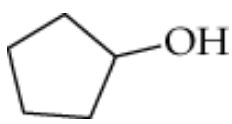
What alkene could you use to make the following products? Draw the structure of the alkene, and tell what other reagent is also required for the reaction to occur.
d. Chemical structure of a cyclopentanol molecule with a hydroxyl group (OH) attached.

검증된 단계별 안내
1
Analyze the given product structure and identify the functional groups present. This will help determine the type of reaction that occurred to form the product.
Recall that alkenes undergo addition reactions with specific reagents to form products. Common addition reactions include hydrogenation, halogenation, hydrohalogenation, and hydration. Match the functional groups in the product to the possible addition reaction.
Determine the structure of the alkene by reversing the addition reaction. For example, if the product contains an alcohol group (-OH), the reaction might have been hydration, and the alkene would have had a double bond where the -OH group is now attached.
Identify the reagent required for the reaction. For hydration reactions, water (H₂O) and an acid catalyst (such as H₂SO₄) are typically used. For halogenation, halogens like Cl₂ or Br₂ are used. Match the reagent to the functional group added in the product.
Draw the structure of the alkene and ensure it aligns with the reverse reaction mechanism. Verify that the addition of the reagent to the alkene would yield the given product.

비슷한 문제에 대한 검증된 영상 답변:

이 영상 해법은 위 문제에 도움이 된다고 튜터들이 추천한 것입니다.
도움이 되었나요?

주요 개념

질문에 올바르게 답하기 위해 반드시 이해해야 하는 핵심 개념들은 다음과 같습니다.

Alkenes

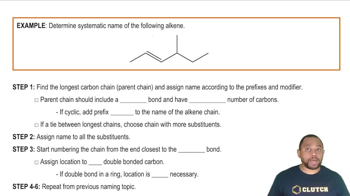
Alkenes are hydrocarbons that contain at least one carbon-carbon double bond (C=C). They are unsaturated compounds, meaning they have fewer hydrogen atoms than alkanes with the same number of carbon atoms. Alkenes are reactive and can undergo various chemical reactions, including addition reactions, where other atoms or groups are added across the double bond.
추천 영상:
가이드 코스
3:26
Naming Alkenes Example 1

Addition Reactions

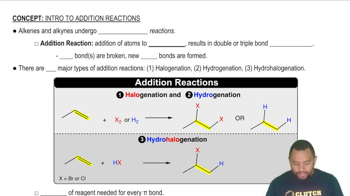
Addition reactions are a type of chemical reaction where two or more reactants combine to form a single product. In the context of alkenes, these reactions often involve the addition of halogens, hydrogen, or water across the double bond. Understanding the specific conditions and reagents required for these reactions is crucial for predicting the products formed from a given alkene.
추천 영상:
가이드 코스
2:55
Addition Reactions Concept 1

Reagents

Reagents are substances that are added to a chemical reaction to cause a change or to facilitate the reaction. In the case of alkenes, common reagents include hydrogen (for hydrogenation), halogens (for halogenation), and acids (for hydration). Identifying the correct reagent is essential for determining the products of the reaction and understanding the mechanism involved.
추천 영상:
가이드 코스
01:30
Limiting Reagent