Ch.14 Some Compounds with Oxygen, Sulfur, or a Halogen
McMurry - Fundamentals of General, Organic, and Biological Chemistry 8th Edition
McMurry8th EditionFundamentals of General, Organic, and Biological ChemistryISBN: 9780134015187당신이 사용하는 게 아니라요?교과서 변경
14장, 문제 19

2-Aminopropane is an achiral molecule, but 2-aminobutane is chiral. Explain.

검증된 단계별 안내
1
Identify the concept of chirality: A molecule is chiral if it has a carbon atom bonded to four different groups, making it non-superimposable on its mirror image. If a molecule lacks this property, it is achiral.
Analyze the structure of 2-aminopropane: The central carbon atom in 2-aminopropane is bonded to a methyl group (-CH3), an amino group (-NH2), a hydrogen atom (-H), and another methyl group (-CH3). Since two of the groups are identical (both are methyl groups), the central carbon does not have four different groups, making the molecule achiral.
Analyze the structure of 2-aminobutane: The central carbon atom in 2-aminobutane is bonded to a methyl group (-CH3), an amino group (-NH2), a hydrogen atom (-H), and an ethyl group (-CH2CH3). Since all four groups are different, the central carbon is a chiral center, making the molecule chiral.
Compare the two molecules: The key difference lies in the groups attached to the central carbon. In 2-aminopropane, the presence of two identical methyl groups prevents chirality, while in 2-aminobutane, the presence of four distinct groups creates a chiral center.
Conclude: 2-Aminopropane is achiral because it lacks a chiral center, while 2-aminobutane is chiral due to the presence of a carbon atom bonded to four different groups.

비슷한 문제에 대한 검증된 영상 답변:

이 영상 해법은 위 문제에 도움이 된다고 튜터들이 추천한 것입니다.
도움이 되었나요?

주요 개념

질문에 올바르게 답하기 위해 반드시 이해해야 하는 핵심 개념들은 다음과 같습니다.

Chirality

Chirality refers to the geometric property of a molecule that makes it non-superimposable on its mirror image. A chiral molecule typically has a carbon atom bonded to four different substituents, resulting in two distinct forms known as enantiomers. In contrast, achiral molecules can be superimposed on their mirror images, indicating a lack of this asymmetry.
추천 영상:
가이드 코스
1:39
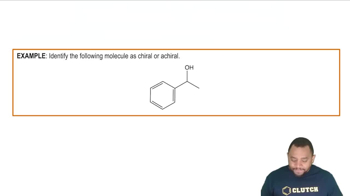
Chirality Example 1

Stereocenters

A stereocenter, often a chiral center, is a specific atom in a molecule, usually carbon, that has four different groups attached to it. The presence of a stereocenter is a key factor in determining whether a molecule is chiral. In the case of 2-aminobutane, the presence of a stereocenter makes it chiral, while 2-aminopropane lacks such a center, rendering it achiral.

Molecular Structure

The molecular structure of a compound refers to the arrangement of atoms within the molecule and the bonds that connect them. This arrangement influences the molecule's properties, including its chirality. For example, 2-aminopropane has a symmetrical structure that does not allow for chirality, while 2-aminobutane's structure introduces asymmetry, leading to its chiral nature.
추천 영상:
가이드 코스
00:34
Molecular Models Example 1