Ch.15 Aldehydes and Ketones
McMurry - Fundamentals of General, Organic, and Biological Chemistry 8th Edition
McMurry8th EditionFundamentals of General, Organic, and Biological ChemistryISBN: 9780134015187당신이 사용하는 게 아니라요?교과서 변경
15장, 문제 29e

Redraw each of the following in line structure format. Indicate which compounds have an aldehyde carbonyl group, a ketone carbonyl group, or neither. 
e. CH3CH2COCH2CH3

검증된 단계별 안내
1
Step 1: Begin by understanding the given molecular formula, CH₃CH₂COCH₂CH₃. This represents a compound with a total of five carbon atoms, where 'CO' indicates the presence of a carbonyl group (C=O).
Step 2: Convert the molecular formula into a line structure. In a line structure, carbon atoms are represented as vertices, and hydrogen atoms are implied based on the valency of carbon. Draw the chain of five carbon atoms, ensuring the carbonyl group (C=O) is placed on the third carbon.
Step 3: Analyze the carbonyl group (C=O) to determine its classification. A carbonyl group is classified as a ketone if it is bonded to two carbon atoms, and as an aldehyde if it is bonded to at least one hydrogen atom.
Step 4: In this structure, the carbonyl group is bonded to two carbon atoms (the second and fourth carbons in the chain). This indicates that the compound contains a ketone carbonyl group.
Step 5: Conclude that the line structure for CH₃CH₂COCH₂CH₃ represents a ketone, as the carbonyl group is not bonded to any hydrogen atoms. Label the structure accordingly to indicate the presence of a ketone carbonyl group.

비슷한 문제에 대한 검증된 영상 답변:

이 영상 해법은 위 문제에 도움이 된다고 튜터들이 추천한 것입니다.
도움이 되었나요?

주요 개념

질문에 올바르게 답하기 위해 반드시 이해해야 하는 핵심 개념들은 다음과 같습니다.

Carbonyl Groups

Carbonyl groups are functional groups characterized by a carbon atom double-bonded to an oxygen atom (C=O). They are classified into two main types: aldehydes, where the carbonyl is at the end of a carbon chain, and ketones, where it is located within the chain. Understanding the position of the carbonyl group is crucial for identifying the type of compound and its reactivity.
추천 영상:
가이드 코스
1:00
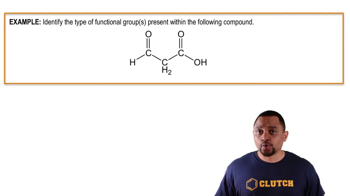
Functional Groups with Carbonyls Example 3

Structural Representation

Structural representation in chemistry refers to the way molecules are depicted to show the arrangement of atoms and the bonds between them. Line structure format simplifies this by using lines to represent bonds, with vertices representing carbon atoms. This format is essential for visualizing molecular structure and understanding functional groups like carbonyls.
추천 영상:
가이드 코스
2:08
Molecular Representations Concept 1

Functional Groups

Functional groups are specific groups of atoms within molecules that are responsible for the characteristic chemical reactions of those molecules. In organic chemistry, identifying functional groups such as aldehydes and ketones is vital for predicting the behavior of compounds. Recognizing these groups helps in classifying compounds and understanding their properties and reactivity.
추천 영상:
가이드 코스
1:11
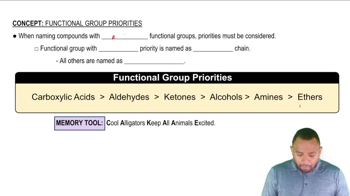
Functional Group Priorities Concept 1