Ch.15 Aldehydes and Ketones
McMurry - Fundamentals of General, Organic, and Biological Chemistry 8th Edition
McMurry8th EditionFundamentals of General, Organic, and Biological ChemistryISBN: 9780134015187당신이 사용하는 게 아니라요?교과서 변경
15장, 문제 20b

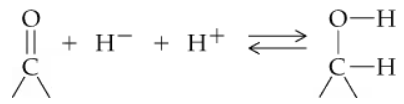
The carbonyl group can be reduced by addition of a hydride ion (H) and (H+) a proton. Removal of H and H+ from an alcohol results in a carbonyl group.

b. In the reaction, indicate which direction represents reduction and which represents oxidation.

검증된 단계별 안내
1
Understand the key concepts: Reduction involves the gain of electrons or hydrogen (H⁻ and H⁺), while oxidation involves the loss of electrons or hydrogen. In organic chemistry, reduction often converts a carbonyl group (C=O) to an alcohol (C-OH), and oxidation does the reverse.
Identify the functional groups involved: A carbonyl group (C=O) is being converted to an alcohol (C-OH) in one direction, and the alcohol is being converted back to a carbonyl group in the opposite direction.
Determine the direction of reduction: The addition of H⁻ (hydride ion) and H⁺ (proton) to the carbonyl group (C=O) results in the formation of an alcohol (C-OH). This process represents reduction because hydrogen is being added.
Determine the direction of oxidation: The removal of H⁻ (hydride ion) and H⁺ (proton) from the alcohol (C-OH) results in the formation of a carbonyl group (C=O). This process represents oxidation because hydrogen is being removed.
Summarize the directions: The conversion of a carbonyl group (C=O) to an alcohol (C-OH) is reduction, while the conversion of an alcohol (C-OH) to a carbonyl group (C=O) is oxidation.

비슷한 문제에 대한 검증된 영상 답변:

이 영상 해법은 위 문제에 도움이 된다고 튜터들이 추천한 것입니다.

주요 개념

질문에 올바르게 답하기 위해 반드시 이해해야 하는 핵심 개념들은 다음과 같습니다.

Reduction and Oxidation

Reduction and oxidation are fundamental chemical processes that involve the transfer of electrons. Reduction refers to the gain of electrons or hydrogen, while oxidation involves the loss of electrons or hydrogen. In organic chemistry, the addition of a hydride ion (H⁻) to a carbonyl group signifies reduction, whereas the removal of H⁻ and H⁺ from an alcohol to form a carbonyl indicates oxidation.
추천 영상:
가이드 코스
0:55
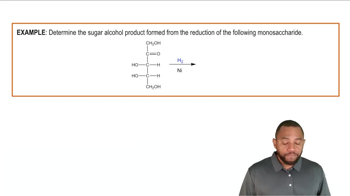
Reduction of Monosaccharides Example 1

Carbonyl Group

The carbonyl group (C=O) is a functional group characterized by a carbon atom double-bonded to an oxygen atom. It is a key feature in various organic compounds, including aldehydes and ketones. Understanding the reactivity of the carbonyl group is essential for predicting the outcomes of reduction and oxidation reactions, as it can easily undergo transformations with the addition or removal of hydrogen.
추천 영상:
가이드 코스
1:00
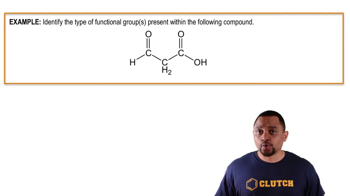
Functional Groups with Carbonyls Example 3

Hydride Ion (H⁻)

A hydride ion (H⁻) is a negatively charged ion formed when a hydrogen atom gains an electron. In reduction reactions, hydride ions act as strong reducing agents, donating electrons to other molecules, such as carbonyl compounds. This process is crucial in organic synthesis, as it allows for the conversion of carbonyl groups into alcohols, demonstrating the practical applications of reduction in chemical reactions.
추천 영상:
가이드 코스
02:31
Polyatomic Ions