Ch.15 Aldehydes and Ketones
McMurry - Fundamentals of General, Organic, and Biological Chemistry 8th Edition
McMurry8th EditionFundamentals of General, Organic, and Biological ChemistryISBN: 9780134015187당신이 사용하는 게 아니라요?교과서 변경
15장, 문제 46

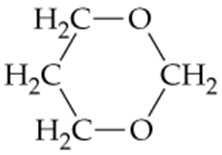
What two products result from the complete hydrolysis of this cyclic acetal?

검증된 단계별 안내
1
Identify the structure of the cyclic acetal in the image. Cyclic acetals are formed when a carbon atom is bonded to two -OR groups (alkoxy groups) and one -R group (alkyl group). This structure is typically derived from the reaction of an aldehyde or ketone with a diol.
Understand the concept of hydrolysis. Hydrolysis is a reaction where water breaks chemical bonds. In the case of cyclic acetals, hydrolysis breaks the acetal bond, regenerating the original carbonyl compound (aldehyde or ketone) and the diol used to form the acetal.
Determine the carbonyl compound. Look at the carbon atom in the cyclic acetal that is bonded to the two -OR groups. When hydrolyzed, this carbon will revert to its original carbonyl form (C=O), either as an aldehyde or ketone, depending on the structure.
Determine the diol. The two -OR groups in the cyclic acetal are derived from a diol. Identify the diol by examining the two oxygen atoms in the cyclic structure and the carbon chain connecting them.
Write the products of the reaction. The complete hydrolysis of the cyclic acetal will yield the carbonyl compound (aldehyde or ketone) and the diol. Ensure the chemical structures are balanced and consistent with the original cyclic acetal.

비슷한 문제에 대한 검증된 영상 답변:

이 영상 해법은 위 문제에 도움이 된다고 튜터들이 추천한 것입니다.

주요 개념

질문에 올바르게 답하기 위해 반드시 이해해야 하는 핵심 개념들은 다음과 같습니다.

Cyclic Acetal Structure

Cyclic acetals are formed from the reaction of aldehydes or ketones with alcohols, resulting in a stable ring structure. Understanding the molecular structure of cyclic acetals is crucial for predicting their behavior during hydrolysis, as the ring must be opened to revert to the original carbonyl compound and alcohol.
추천 영상:
가이드 코스
2:49
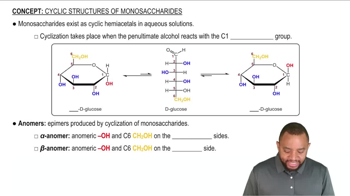
Cyclic Structures of Monosaccharides Concept 1

Hydrolysis Reaction

Hydrolysis is a chemical reaction involving the breakdown of a compound by water. In the case of cyclic acetals, hydrolysis leads to the cleavage of the acetal bond, resulting in the formation of the corresponding carbonyl compound and alcohol. Recognizing the conditions under which hydrolysis occurs is essential for determining the products.
추천 영상:
가이드 코스
3:09
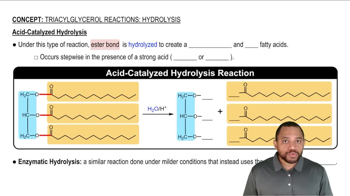
Triacylglycerol Reactions: Hydrolysis Concept 1

Products of Hydrolysis

The complete hydrolysis of a cyclic acetal typically yields a carbonyl compound (aldehyde or ketone) and an alcohol. Identifying these products requires knowledge of the specific acetal structure and the nature of the original carbonyl compound. This understanding is vital for predicting the outcome of the hydrolysis reaction.
추천 영상:
가이드 코스
0:52
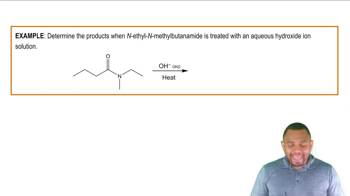
Basic Hydrolysis Example 2