Ch.15 Aldehydes and Ketones
McMurry - Fundamentals of General, Organic, and Biological Chemistry 8th Edition
McMurry8th EditionFundamentals of General, Organic, and Biological ChemistryISBN: 9780134015187당신이 사용하는 게 아니라요?교과서 변경
15장, 문제 38

Which of the following compounds will react with Tollens' reagent? With Benedict's reagent?
a. Cyclopentanon
b. Hexanal
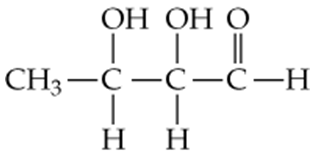
c.

검증된 단계별 안내
1
Step 1: Understand the reagents. Tollens' reagent is a mild oxidizing agent that reacts with aldehydes to form a silver mirror, but it does not react with ketones. Benedict's reagent is another oxidizing agent that reacts with aldehydes and reducing sugars, but not with ketones.
Step 2: Analyze compound (a), Cyclopentanone. Cyclopentanone is a ketone, as indicated by the '-one' suffix. Ketones do not have a hydrogen atom attached to the carbonyl carbon, so they do not react with either Tollens' or Benedict's reagent.
Step 3: Analyze compound (b), Hexanal. Hexanal is an aldehyde, as indicated by the '-al' suffix. Aldehydes have a hydrogen atom attached to the carbonyl carbon, making them reactive with both Tollens' and Benedict's reagents. Hexanal will react with both reagents.
Step 4: Analyze compound (c), represented by the image. Carefully examine the structure in the image to determine if it contains an aldehyde group (–CHO) or a ketone group (C=O). If it has an aldehyde group, it will react with both reagents. If it has a ketone group, it will not react with either reagent.
Step 5: Summarize the reactivity of each compound. Cyclopentanone does not react with either reagent, Hexanal reacts with both reagents, and the reactivity of the compound in the image depends on its functional group (aldehyde or ketone).

비슷한 문제에 대한 검증된 영상 답변:

이 영상 해법은 위 문제에 도움이 된다고 튜터들이 추천한 것입니다.
도움이 되었나요?

주요 개념

질문에 올바르게 답하기 위해 반드시 이해해야 하는 핵심 개념들은 다음과 같습니다.

Tollens' Reagent

Tollens' reagent is a solution of silver nitrate in ammonia, used to test for aldehydes. When an aldehyde is present, it reduces the silver ions to metallic silver, resulting in a characteristic silver mirror on the test container. This reagent does not react with ketones, making it a selective test for aldehydes.
추천 영상:
가이드 코스
01:30
Limiting Reagent

Benedict's Reagent

Benedict's reagent is a blue solution containing copper(II) sulfate, which is used to test for reducing sugars and aldehydes. When heated with a reducing sugar or an aldehyde, the copper(II) ions are reduced to copper(I) oxide, forming a colored precipitate ranging from green to brick red, depending on the amount of reducing sugar present.
추천 영상:
가이드 코스
01:30
Limiting Reagent

Aldehydes vs. Ketones

Aldehydes and ketones are both carbonyl compounds, but they differ in structure and reactivity. Aldehydes have the carbonyl group at the end of the carbon chain, making them more reactive towards oxidizing agents like Tollens' and Benedict's reagents. In contrast, ketones have the carbonyl group within the carbon chain and generally do not react with these reagents.
추천 영상:
가이드 코스
1:57
Reduction of Aldehydes and Ketones Concept 2