Ch.16 Amines
McMurry - Fundamentals of General, Organic, and Biological Chemistry 8th Edition
McMurry8th EditionFundamentals of General, Organic, and Biological ChemistryISBN: 9780134015187당신이 사용하는 게 아니라요?교과서 변경
16장, 문제 41a

Complete the following equations (hint: remember that a nitrogen with three groups bound to it has a lone pair and one with four does not):
a. Chemical equation showing a reaction involving a nitrogen compound and HBr, with a question mark indicating an unknown product.

검증된 단계별 안내
1
Identify the type of nitrogen atom in the given molecule. Determine whether it has three groups bound to it (indicating a lone pair is present) or four groups (indicating no lone pair). This will help you predict its reactivity and bonding behavior.
Examine the chemical context of the reaction. If the nitrogen has a lone pair, it can act as a nucleophile or base, depending on the reaction conditions. If it has four groups, it is likely a positively charged ammonium ion and cannot donate electrons.
Balance the chemical equation by ensuring that the number of atoms of each element and the overall charge are the same on both sides of the equation. Use stoichiometric coefficients as needed.
Consider the role of the nitrogen-containing compound in the reaction. For example, if it is reacting with an acid, the lone pair on nitrogen may accept a proton (H⁺), forming an ammonium ion. Write the products accordingly.
Double-check the completed equation to ensure it adheres to the rules of chemical reactivity and conservation of mass and charge. Verify that the nitrogen atom's bonding and charge are consistent with its role in the reaction.

비슷한 문제에 대한 검증된 영상 답변:

이 영상 해법은 위 문제에 도움이 된다고 튜터들이 추천한 것입니다.
도움이 되었나요?

주요 개념

질문에 올바르게 답하기 위해 반드시 이해해야 하는 핵심 개념들은 다음과 같습니다.

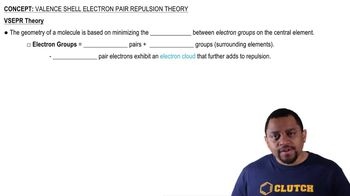
Valence Shell Electron Pair Repulsion (VSEPR) Theory

VSEPR theory is a model used to predict the geometry of individual molecules based on the repulsion between electron pairs in the valence shell of the central atom. According to this theory, electron pairs will arrange themselves as far apart as possible to minimize repulsion, which helps determine the molecular shape. This is crucial for understanding how nitrogen's bonding and lone pairs affect the overall structure of the molecule.
추천 영상:
가이드 코스
01:04
Valence Shell Electron Pair Repulsion Theory (Simplified) Concept 1

Hybridization

Hybridization is the concept of mixing atomic orbitals to form new hybrid orbitals that can accommodate the bonding and lone pairs of electrons in a molecule. For nitrogen, sp3 hybridization occurs when it forms four bonds, resulting in a tetrahedral shape, while sp2 hybridization occurs with three bonds and one lone pair, leading to a trigonal planar shape. Understanding hybridization is essential for predicting molecular geometry and reactivity.
추천 영상:
가이드 코스
01:59
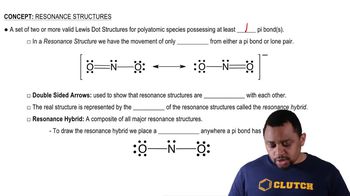
Resonance Structures (Simplified) Concept 1

Lone Pairs

Lone pairs are pairs of valence electrons that are not involved in bonding and are localized on a single atom. In the case of nitrogen, a lone pair can significantly influence the molecular geometry and reactivity of compounds. Recognizing the presence of lone pairs is vital for accurately completing molecular equations and understanding the behavior of nitrogen in various chemical contexts.
추천 영상:
가이드 코스
2:56
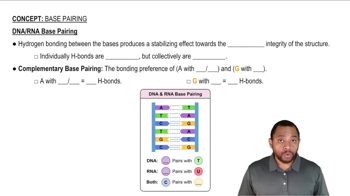
Base Pairing Concept 1