Ch.16 Amines
McMurry - Fundamentals of General, Organic, and Biological Chemistry 8th Edition
McMurry8th EditionFundamentals of General, Organic, and Biological ChemistryISBN: 9780134015187당신이 사용하는 게 아니라요?교과서 변경
16장, 문제 36a

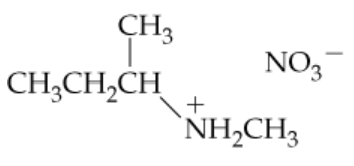
Give names or structures for the following ammonium salts. Indicate whether each is the ammonium salt of a primary, secondary, or tertiary amine.
a. Chemical structure of an ammonium salt with a positively charged nitrogen and a nitrate anion.

검증된 단계별 안내
1
Step 1: Understand the structure of ammonium salts. Ammonium salts are ionic compounds formed when an amine reacts with an acid, resulting in the protonation of the nitrogen atom in the amine to form an ammonium ion (R₃N⁺H or R₂NH₂⁺, etc.).
Step 2: Analyze the given structure (IMAGE) to identify the organic groups (R groups) attached to the nitrogen atom. Count the number of organic groups and hydrogen atoms bonded to the nitrogen to determine if the amine is primary (RNH₂), secondary (R₂NH), or tertiary (R₃N).
Step 3: Name the ammonium ion. Use the names of the organic groups attached to the nitrogen, followed by the word 'ammonium.' For example, if the groups are methyl (CH₃), the name would be 'methylammonium' for a primary amine, 'dimethylammonium' for a secondary amine, or 'trimethylammonium' for a tertiary amine.
Step 4: Identify the counterion (anion) in the salt. The counterion is derived from the acid used in the reaction. For example, if the acid is hydrochloric acid (HCl), the counterion will be chloride (Cl⁻). Combine the ammonium ion name with the counterion to name the salt (e.g., methylammonium chloride).
Step 5: Indicate the type of amine (primary, secondary, or tertiary) based on the number of organic groups attached to the nitrogen atom. This classification is important for understanding the reactivity and properties of the compound.

비슷한 문제에 대한 검증된 영상 답변:

이 영상 해법은 위 문제에 도움이 된다고 튜터들이 추천한 것입니다.
도움이 되었나요?

주요 개념

질문에 올바르게 답하기 위해 반드시 이해해야 하는 핵심 개념들은 다음과 같습니다.

Ammonium Salts

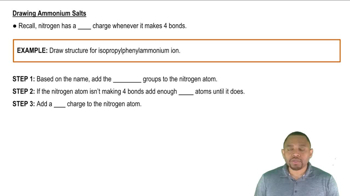
Ammonium salts are ionic compounds formed from the protonation of ammonia (NH3) or amines, where the nitrogen atom carries a positive charge. These salts typically consist of a positively charged ammonium ion (NH4+) and a negatively charged anion. They are commonly used in various applications, including fertilizers and pharmaceuticals.
추천 영상:
가이드 코스
1:04
Drawing Ammonium Salts Concept 2

Amines Classification

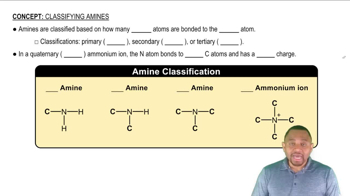
Amines are classified based on the number of carbon groups attached to the nitrogen atom. Primary amines have one carbon group, secondary amines have two, and tertiary amines have three. This classification affects the properties and reactivity of the amines, which in turn influences the characteristics of the corresponding ammonium salts.
추천 영상:
가이드 코스
1:26
Amine Classification Concept 1

Protonation and Salt Formation

Protonation is the process by which a base, such as an amine, gains a proton (H+) to form a positively charged ion. In the context of ammonium salts, this process leads to the formation of the ammonium ion. Understanding protonation is crucial for determining the structure and classification of the resulting ammonium salts based on the original amine.
추천 영상: