Ch.17 Carboxylic Acids and Their Derivatives
McMurry - Fundamentals of General, Organic, and Biological Chemistry 8th Edition
McMurry8th EditionFundamentals of General, Organic, and Biological ChemistryISBN: 9780134015187당신이 사용하는 게 아니라요?교과서 변경
17장, 문제 34c

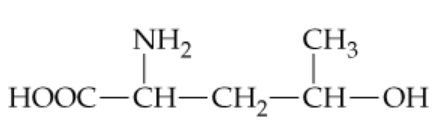
Consider the following unnatural amino acid:
Structural formula of an unnatural amino acid with a carboxyl and hydroxyl group, illustrating potential cyclic ester formation.
c. Draw the cyclic ester resulting from the intramolecular reaction of the hydroxyl group of this amino acid with its carboxyl group (cyclic esters are called lactones).

검증된 단계별 안내
1
Identify the functional groups in the given unnatural amino acid: a hydroxyl (-OH) group and a carboxyl (-COOH) group. These groups are key to forming the cyclic ester (lactone).
Recognize that the intramolecular reaction involves the nucleophilic attack of the hydroxyl group (-OH) on the carbonyl carbon of the carboxyl group (-COOH). This reaction forms an ester bond (-COO-).
Determine the size of the ring that will form. Count the number of atoms in the chain between the hydroxyl group and the carboxyl group, including the oxygen atom from the hydroxyl group and the carbonyl carbon. This will help you predict whether the lactone is a 5-membered or 6-membered ring.
Draw the structure of the cyclic ester (lactone). Ensure that the hydroxyl group is now part of the ester bond, and the carboxyl group has been converted into the ester functional group. The ring should include the appropriate number of atoms based on the chain length.
Verify the structure by checking that all atoms have the correct number of bonds and that the cyclic ester is properly formed. Ensure that the reaction conserves the molecular formula of the original amino acid.

비슷한 문제에 대한 검증된 영상 답변:

이 영상 해법은 위 문제에 도움이 된다고 튜터들이 추천한 것입니다.

주요 개념

질문에 올바르게 답하기 위해 반드시 이해해야 하는 핵심 개념들은 다음과 같습니다.

Cyclic Esters (Lactones)

Cyclic esters, known as lactones, are formed when a hydroxyl group reacts with a carboxyl group within the same molecule, resulting in a ring structure. This reaction typically occurs through a condensation process, where water is eliminated. Lactones are significant in organic chemistry and biochemistry, as they can influence the properties and reactivity of compounds, including amino acids.
추천 영상:
가이드 코스
2:55
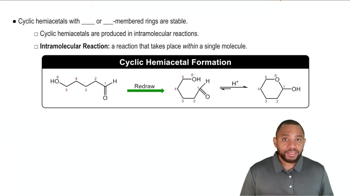
Cyclic Hemiacetals Concept 2

Intramolecular Reactions

Intramolecular reactions occur within a single molecule, where functional groups react with each other to form new structures. In the context of amino acids, this can lead to the formation of cyclic compounds, such as lactones, which can affect the molecule's stability and biological activity. Understanding these reactions is crucial for predicting the behavior of amino acids in various chemical environments.
추천 영상:
가이드 코스
2:04
Intermolecular Forces (Simplified) Example 1

Amino Acid Structure

Amino acids are organic compounds characterized by a central carbon atom bonded to an amino group, a carboxyl group, a hydrogen atom, and a variable R group (side chain). The specific structure of the R group determines the properties and classification of the amino acid. In the case of unnatural amino acids, modifications to the standard structure can lead to unique reactivity and the potential for forming cyclic esters through intramolecular reactions.
추천 영상:
가이드 코스
3:03
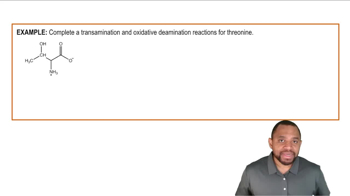
Amino Acid Catabolism: Amino Group Example 2