Ch.18 Amino Acids and Proteins
McMurry - Fundamentals of General, Organic, and Biological Chemistry 8th Edition
McMurry8th EditionFundamentals of General, Organic, and Biological ChemistryISBN: 9780134015187당신이 사용하는 게 아니라요?교과서 변경
18장, 문제 39

Threonine has two chiral centers. Draw L-threonine and indicate which carbon atoms are chiral. Which carbon atom is responsible for D and L configuration?

검증된 단계별 안내
1
Understand the structure of threonine: Threonine is an amino acid with the molecular formula C4H9NO3. It contains an amino group (-NH2), a carboxyl group (-COOH), a hydroxyl group (-OH), and a side chain with a methyl group (-CH3).
Identify the chiral centers: A chiral center is a carbon atom that is bonded to four different groups. In threonine, examine each carbon atom to determine which ones meet this criterion. You will find that the second carbon (C2, the alpha carbon) and the third carbon (C3) are chiral centers.
Draw the structure of l-threonine: Use the Fischer projection to represent the molecule. Place the amino group (-NH2) on the left, the carboxyl group (-COOH) at the top, the hydroxyl group (-OH) on the right, and the methyl group (-CH3) at the bottom. Ensure the configuration corresponds to the l-isomer, which is based on the orientation of the amino group relative to the chiral alpha carbon (C2).
Determine which carbon atom is responsible for d and l configuration: The d and l configuration is determined by the orientation of the groups around the alpha carbon (C2). Specifically, the position of the amino group (-NH2) relative to the other groups determines whether the molecule is in the d or l configuration.
Label the chiral carbons: Clearly indicate the two chiral carbons (C2 and C3) in your drawing. Highlight that the alpha carbon (C2) is the one responsible for the d and l configuration, while the other chiral carbon (C3) contributes to the overall stereochemistry of the molecule.

비슷한 문제에 대한 검증된 영상 답변:

이 영상 해법은 위 문제에 도움이 된다고 튜터들이 추천한 것입니다.
도움이 되었나요?

주요 개념

질문에 올바르게 답하기 위해 반드시 이해해야 하는 핵심 개념들은 다음과 같습니다.

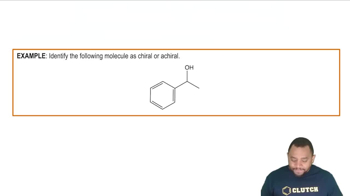
Chirality

Chirality refers to the geometric property of a molecule having non-superimposable mirror images, much like left and right hands. A chiral center, typically a carbon atom, is bonded to four different substituents, leading to two distinct configurations known as enantiomers. In the case of threonine, the presence of two chiral centers means it can exist in multiple stereoisomeric forms.
추천 영상:
가이드 코스
1:39
Chirality Example 1

Stereochemistry

Stereochemistry is the study of the spatial arrangement of atoms in molecules and how this affects their chemical behavior. It encompasses concepts such as enantiomers and diastereomers, which are types of stereoisomers. Understanding stereochemistry is crucial for identifying the specific three-dimensional orientations of the chiral centers in threonine and determining its optical activity.
추천 영상:
가이드 코스
1:30
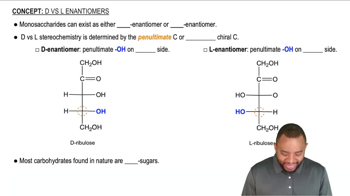
D vs L Enantiomers Concept 1

D and L Configuration

The D and L configuration system is a way to denote the stereochemistry of amino acids based on the orientation of the amino group relative to the chiral carbon furthest from the carboxyl group. In threonine, the specific arrangement of its chiral centers determines whether it is classified as D-threonine or L-threonine. This classification is essential for understanding the biological roles of amino acids in proteins.
추천 영상:
가이드 코스
1:30
D vs L Enantiomers Concept 1