Ch.18 Amino Acids and Proteins
McMurry - Fundamentals of General, Organic, and Biological Chemistry 8th Edition
McMurry8th EditionFundamentals of General, Organic, and Biological ChemistryISBN: 9780134015187당신이 사용하는 게 아니라요?교과서 변경
18장, 문제 84b

What is meant by the following terms as they apply to protein structure, and what bonds or molecular interactions stabilize that level of structure?
b. Secondary structure

검증된 단계별 안내
1
Understand that the secondary structure of a protein refers to the local folding of the polypeptide chain into specific patterns, such as alpha-helices and beta-pleated sheets. These structures are stabilized by hydrogen bonds between the backbone amide hydrogen (N-H) and carbonyl oxygen (C=O) groups of the polypeptide chain.
Recognize that alpha-helices are coiled structures where the hydrogen bonds form between the carbonyl oxygen of one amino acid and the amide hydrogen of an amino acid four residues away. This creates a helical shape.
Identify that beta-pleated sheets consist of strands of polypeptides lying side by side, which can be parallel or antiparallel. Hydrogen bonds form between the carbonyl oxygen of one strand and the amide hydrogen of another strand, stabilizing the sheet-like structure.
Note that secondary structures do not involve interactions between the side chains (R groups) of amino acids; they are solely dependent on the backbone interactions.
Understand that the stability of secondary structures is influenced by the sequence of amino acids, as certain residues (e.g., proline) can disrupt these structures due to their unique properties.

비슷한 문제에 대한 검증된 영상 답변:

이 영상 해법은 위 문제에 도움이 된다고 튜터들이 추천한 것입니다.
도움이 되었나요?

주요 개념

질문에 올바르게 답하기 위해 반드시 이해해야 하는 핵심 개념들은 다음과 같습니다.

Secondary Structure

Secondary structure refers to the local folding patterns of a protein, primarily stabilized by hydrogen bonds between the backbone amide and carbonyl groups. The most common forms of secondary structure are alpha helices and beta sheets, which contribute to the overall shape and stability of the protein. These structures are crucial for the protein's function, as they create specific spatial arrangements that facilitate interactions with other molecules.
추천 영상:
가이드 코스
1:24
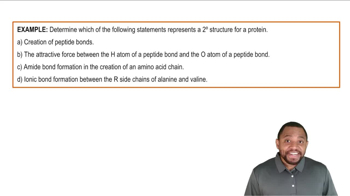
Secondary Protein Structure Example 2

Hydrogen Bonds

Hydrogen bonds are weak interactions that occur when a hydrogen atom covalently bonded to an electronegative atom, like oxygen or nitrogen, is attracted to another electronegative atom. In the context of secondary structure, these bonds form between the carbonyl oxygen of one amino acid and the amide hydrogen of another, helping to stabilize the helical or sheet formations. Although individually weak, the cumulative effect of many hydrogen bonds significantly contributes to the stability of protein structures.
추천 영상:
가이드 코스
1:22
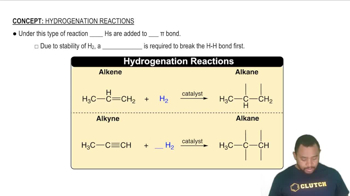
Hydrogenation Reactions Concept 1

Protein Folding

Protein folding is the process by which a linear chain of amino acids acquires its functional three-dimensional structure. This process is driven by various interactions, including hydrogen bonds, hydrophobic interactions, and van der Waals forces. Proper folding is essential for protein functionality, as misfolded proteins can lead to loss of function or diseases, highlighting the importance of secondary structure in the overall stability and activity of proteins.
추천 영상:
가이드 코스
1:17
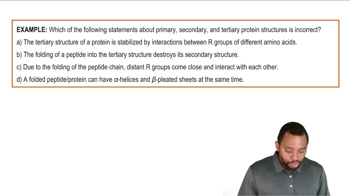
Tertiary Protein Structure Example 1