Ch.18 Amino Acids and Proteins
McMurry - Fundamentals of General, Organic, and Biological Chemistry 8th Edition
McMurry8th EditionFundamentals of General, Organic, and Biological ChemistryISBN: 9780134015187당신이 사용하는 게 아니라요?교과서 변경
18장, 문제 61

Write structural formulas for the two dipeptides that contain leucine and aspartate.

검증된 단계별 안내
1
Understand that a dipeptide is formed by linking two amino acids through a peptide bond, which is a covalent bond formed between the carboxyl group of one amino acid and the amino group of another amino acid, with the release of a water molecule.
Identify the structures of leucine and aspartate. Leucine is a nonpolar, hydrophobic amino acid with the side chain -CH2-CH-(CH3)2, while aspartate is a polar, negatively charged amino acid with the side chain -CH2-COO⁻.
Determine the two possible sequences of the dipeptide: (1) Leucine as the N-terminal amino acid and aspartate as the C-terminal amino acid, and (2) Aspartate as the N-terminal amino acid and leucine as the C-terminal amino acid. The N-terminal refers to the amino acid with the free amino group, and the C-terminal refers to the amino acid with the free carboxyl group.
Draw the structural formula for the first dipeptide (Leu-Asp). Start with the amino group of leucine, connect it to the carboxyl group of aspartate via a peptide bond, and ensure the side chains of leucine and aspartate are correctly represented.
Draw the structural formula for the second dipeptide (Asp-Leu). Start with the amino group of aspartate, connect it to the carboxyl group of leucine via a peptide bond, and ensure the side chains of aspartate and leucine are correctly represented.

비슷한 문제에 대한 검증된 영상 답변:

이 영상 해법은 위 문제에 도움이 된다고 튜터들이 추천한 것입니다.
도움이 되었나요?

주요 개념

질문에 올바르게 답하기 위해 반드시 이해해야 하는 핵심 개념들은 다음과 같습니다.

Dipeptides

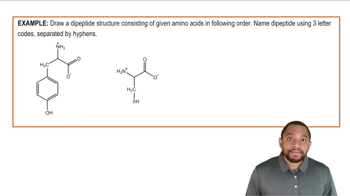
Dipeptides are organic compounds formed by the condensation of two amino acids. In this process, the carboxyl group of one amino acid reacts with the amino group of another, releasing a molecule of water and forming a peptide bond. Understanding the structure and formation of dipeptides is essential for drawing their structural formulas.
추천 영상:
가이드 코스
2:27
Peptides Example 2

Amino Acids

Amino acids are the building blocks of proteins, consisting of a central carbon atom, an amino group, a carboxyl group, a hydrogen atom, and a variable R group that determines the specific properties of each amino acid. Leucine and aspartate are two distinct amino acids, with leucine being non-polar and hydrophobic, while aspartate is polar and negatively charged. Recognizing their structures is crucial for constructing the correct dipeptide formulas.
추천 영상:
가이드 코스
3:03
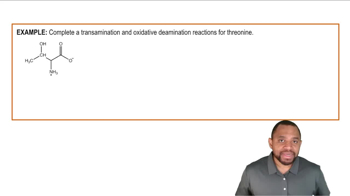
Amino Acid Catabolism: Amino Group Example 2

Structural Formulas

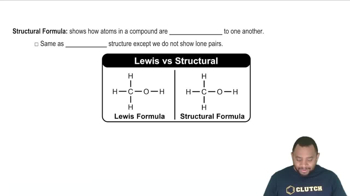
Structural formulas represent the arrangement of atoms within a molecule, illustrating how atoms are bonded together. For dipeptides, the structural formula will show the sequence of amino acids and the peptide bond formed between them. Accurately depicting these structures is vital for understanding the chemical properties and functions of the resulting dipeptides.
추천 영상:
가이드 코스
1:01
Structural Formula Concept 2