Ch.19 Enzymes and Vitamins
McMurry - Fundamentals of General, Organic, and Biological Chemistry 8th Edition
McMurry8th EditionFundamentals of General, Organic, and Biological ChemistryISBN: 9780134015187당신이 사용하는 게 아니라요?교과서 변경
19장, 문제 71

Activation of a zymogen is by covalent modification. How might phosphorylation or dephosphorylation (also covalent modification) modify an enzyme to make it more active (or more inactive)?

검증된 단계별 안내
1
Understand that zymogens are inactive enzyme precursors that require a biochemical change to become active.
Recognize that covalent modification, such as phosphorylation or dephosphorylation, involves the addition or removal of a phosphate group to an enzyme.
Phosphorylation typically involves the addition of a phosphate group from ATP to an amino acid residue (like serine, threonine, or tyrosine) on the enzyme, which can cause a conformational change.
This conformational change can either activate or deactivate the enzyme by altering its active site or its interaction with other molecules.
Dephosphorylation, the removal of a phosphate group, can reverse these changes, potentially restoring the enzyme to its original state or altering its activity further.

비슷한 문제에 대한 검증된 영상 답변:

이 영상 해법은 위 문제에 도움이 된다고 튜터들이 추천한 것입니다.
영상 길이:
4m
도움이 되었나요?

주요 개념

질문에 올바르게 답하기 위해 반드시 이해해야 하는 핵심 개념들은 다음과 같습니다.

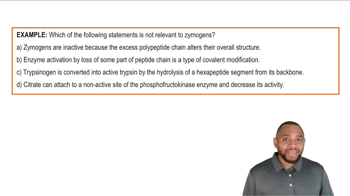
Zymogen Activation

Zymogens are inactive enzyme precursors that require a biochemical change to become active. This activation often involves covalent modifications, such as cleavage of specific peptide bonds, which alters the zymogen's structure and allows it to catalyze reactions. Understanding this process is crucial for grasping how enzymes are regulated in biological systems.
추천 영상:
가이드 코스
2:21
Zymogens Example 1

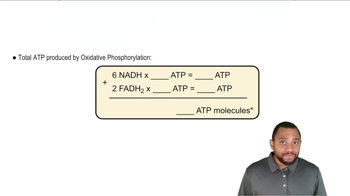
Phosphorylation and Dephosphorylation

Phosphorylation is the addition of a phosphate group to a molecule, typically a protein, which can alter its function and activity. Conversely, dephosphorylation is the removal of a phosphate group. These processes are key regulatory mechanisms in cellular signaling and can either activate or inhibit enzyme activity, depending on the specific enzyme and context.
추천 영상:
가이드 코스
0:51
Oxidative Phosphorylation Concept 2

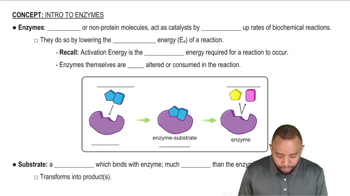
Enzyme Regulation

Enzyme regulation refers to the various mechanisms that control enzyme activity and function within a cell. This includes allosteric regulation, covalent modifications like phosphorylation, and feedback inhibition. Understanding these regulatory mechanisms is essential for comprehending how metabolic pathways are controlled and how cells respond to changes in their environment.
추천 영상:
가이드 코스
2:14
Intro to Enzymes Concept 1