Ch.20 Carbohydrates
McMurry - Fundamentals of General, Organic, and Biological Chemistry 8th Edition
McMurry8th EditionFundamentals of General, Organic, and Biological ChemistryISBN: 9780134015187당신이 사용하는 게 아니라요?교과서 변경
20장, 문제 9a

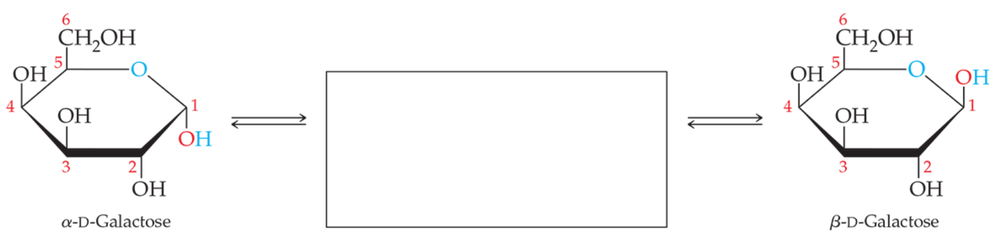
Draw the structure that completes the mutarotation reaction between the two cyclic forms of (a) galactose and (b) fructose.
a. Diagram illustrating the mutarotation reaction between α-D-Galactose and β-D-Galactose with labeled carbon atoms.

검증된 단계별 안내
1
Understand the concept of mutarotation: Mutarotation is the process by which the α and β anomers of a sugar interconvert in aqueous solution through the open-chain form. This occurs because the cyclic forms of sugars are in equilibrium with their linear form.
Identify the cyclic forms of the sugar: For galactose, the two cyclic forms are the α-D-galactopyranose and β-D-galactopyranose. For fructose, the two cyclic forms are the α-D-fructofuranose and β-D-fructofuranose.
Recognize the open-chain intermediate: During mutarotation, the cyclic form of the sugar opens up to form the linear (open-chain) structure. This linear form contains an aldehyde group for galactose (an aldose) and a ketone group for fructose (a ketose).
Draw the open-chain structure: For galactose, draw the linear structure with the aldehyde group at the top and the hydroxyl groups arranged according to the D-configuration. For fructose, draw the linear structure with the ketone group at the second carbon and the hydroxyl groups arranged according to the D-configuration.
Complete the reaction: Show the interconversion between the α and β cyclic forms of galactose and fructose through the open-chain structure. For each sugar, indicate the breaking and reforming of the hemiacetal (galactose) or hemiketal (fructose) bond that leads to the formation of the α and β anomers.

비슷한 문제에 대한 검증된 영상 답변:

이 영상 해법은 위 문제에 도움이 된다고 튜터들이 추천한 것입니다.
영상 길이:
2m
도움이 되었나요?

주요 개념

질문에 올바르게 답하기 위해 반드시 이해해야 하는 핵심 개념들은 다음과 같습니다.

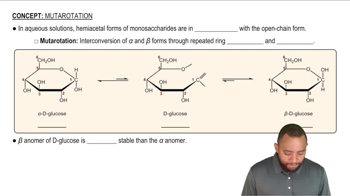
Mutarotation

Mutarotation is the change in optical rotation that occurs when an anomeric carbon in a sugar ring opens and closes, interconverting between its alpha and beta forms. This process is significant in carbohydrates, as it affects their reactivity and interaction with other molecules. For example, in the case of galactose and fructose, mutarotation allows the cyclic forms to equilibrate, leading to a mixture of anomers.
추천 영상:
가이드 코스
2:10
Mutarotation Concept 1

Cyclic Forms of Sugars

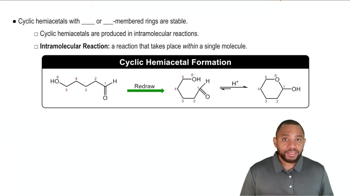
Cyclic forms of sugars, also known as hemiacetals or hemiketals, are the structures that sugars adopt when they react with themselves to form a ring. For instance, galactose can exist in both pyranose (six-membered) and furanose (five-membered) forms, while fructose primarily exists as a furanose. Understanding these structures is crucial for predicting the outcomes of reactions like mutarotation.
추천 영상:
가이드 코스
2:55
Cyclic Hemiacetals Concept 2

Anomeric Carbon

The anomeric carbon is the carbon atom in a sugar that was the carbonyl carbon in its open-chain form and becomes a new stereocenter when the sugar cyclizes. This carbon is pivotal in determining the alpha or beta configuration of the sugar. In the context of mutarotation, the anomeric carbon's configuration changes, leading to the interconversion between different cyclic forms of sugars like galactose and fructose.
추천 영상:
가이드 코스
5:36
Amino Acid Catabolism: Carbon Atoms Concept 2