Ch.21 The Generation of Biochemical Energy
McMurry - Fundamentals of General, Organic, and Biological Chemistry 8th Edition
McMurry8th EditionFundamentals of General, Organic, and Biological ChemistryISBN: 9780134015187당신이 사용하는 게 아니라요?교과서 변경
21장, 문제 65

What atom in the cytochromes undergoes oxidation and reduction in the electron-transport chain? What atoms in coenzyme Q undergo oxidation and reduction in the electron-transport chain?

검증된 단계별 안내
1
Understand the role of cytochromes in the electron-transport chain: Cytochromes are proteins that contain a heme group, which is responsible for their ability to undergo oxidation and reduction. The heme group contains an iron (Fe) atom that alternates between two oxidation states: Fe²⁺ (reduced) and Fe³⁺ (oxidized).
Identify the atom in cytochromes that undergoes oxidation and reduction: The iron (Fe) atom in the heme group of cytochromes is the one that undergoes these redox changes as it accepts and donates electrons during the electron-transport chain.
Understand the role of coenzyme Q (ubiquinone) in the electron-transport chain: Coenzyme Q is a lipid-soluble molecule that shuttles electrons between complexes in the electron-transport chain. It undergoes redox reactions as it transitions between its oxidized form (ubiquinone, Q) and its reduced forms (ubiquinol, QH₂).
Identify the atoms in coenzyme Q involved in redox reactions: The redox activity of coenzyme Q occurs at the oxygen atoms in its quinone group. During reduction, these oxygen atoms gain electrons and protons, converting the quinone group into a hydroquinone group.
Summarize the key atoms involved: In cytochromes, the iron (Fe) atom in the heme group undergoes oxidation and reduction. In coenzyme Q, the oxygen atoms in the quinone group are involved in the redox reactions as they transition between oxidized and reduced states.

비슷한 문제에 대한 검증된 영상 답변:

이 영상 해법은 위 문제에 도움이 된다고 튜터들이 추천한 것입니다.
영상 길이:
4m

주요 개념

질문에 올바르게 답하기 위해 반드시 이해해야 하는 핵심 개념들은 다음과 같습니다.

Cytochromes

Cytochromes are heme-containing proteins that play a crucial role in the electron transport chain (ETC) within mitochondria. They facilitate the transfer of electrons through a series of redox reactions, where the iron atom in the heme group undergoes oxidation and reduction. This process is essential for the generation of ATP, as it helps to create a proton gradient across the mitochondrial membrane.

Coenzyme Q (Ubiquinone)

Coenzyme Q, also known as ubiquinone, is a lipid-soluble molecule that acts as an electron carrier in the electron transport chain. It can undergo both oxidation and reduction, specifically by accepting electrons from various sources, including cytochromes and other electron donors. This ability to shuttle electrons between different complexes in the ETC is vital for efficient energy production in aerobic respiration.
추천 영상:
가이드 코스
1:02
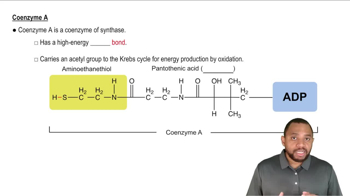
Coenzyme A Concept 4

Electron Transport Chain (ETC)

The electron transport chain is a series of protein complexes and other molecules located in the inner mitochondrial membrane that facilitate the transfer of electrons derived from nutrients. As electrons move through the chain, they release energy used to pump protons across the membrane, creating a proton gradient. This gradient drives ATP synthesis through ATP synthase, making the ETC a central component of cellular respiration and energy metabolism.
추천 영상:
가이드 코스
3:10
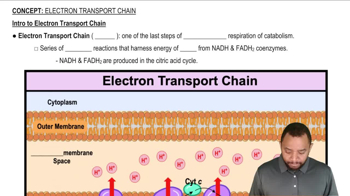
Intro to Electron Transport Chain Concept 1