Ch.21 The Generation of Biochemical Energy
McMurry - Fundamentals of General, Organic, and Biological Chemistry 8th Edition
McMurry8th EditionFundamentals of General, Organic, and Biological ChemistryISBN: 9780134015187당신이 사용하는 게 아니라요?교과서 변경
21장, 문제 44

What general kind of chemical reaction does ATP participate in?

검증된 단계별 안내
1
Understand that ATP (adenosine triphosphate) is a molecule that stores and transfers energy in cells. It is often involved in reactions where energy is required or released.
Recognize that ATP participates in hydrolysis reactions, which are a type of chemical reaction where a water molecule is used to break a bond in a compound.
In the case of ATP, hydrolysis typically involves breaking the bond between the terminal phosphate group and the rest of the molecule, resulting in the formation of ADP (adenosine diphosphate) and an inorganic phosphate (Pi).
Write the general chemical equation for ATP hydrolysis: ATP + H2O → ADP + Pi + energy. This reaction releases energy that can be used by the cell for various processes.
Conclude that ATP hydrolysis is an example of a catabolic reaction (breaking down molecules) and is also classified as an exergonic reaction because it releases energy.

비슷한 문제에 대한 검증된 영상 답변:

이 영상 해법은 위 문제에 도움이 된다고 튜터들이 추천한 것입니다.
영상 길이:
54s

주요 개념

질문에 올바르게 답하기 위해 반드시 이해해야 하는 핵심 개념들은 다음과 같습니다.

ATP (Adenosine Triphosphate)

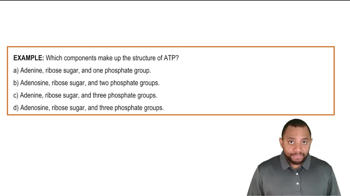
ATP is a nucleotide that serves as the primary energy carrier in cells. It consists of adenine, ribose, and three phosphate groups. The high-energy bonds between the phosphate groups store energy, which is released when ATP is hydrolyzed to ADP (Adenosine Diphosphate) and inorganic phosphate, making it crucial for various cellular processes.
추천 영상:
가이드 코스
1:03
Adenosine Triphosphate (ATP) Example 2

Hydrolysis Reaction

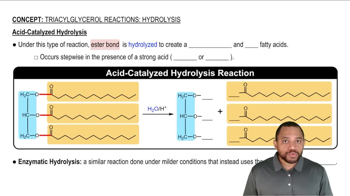
Hydrolysis is a type of chemical reaction where water is used to break down a compound. In the context of ATP, hydrolysis involves the cleavage of one of its phosphate bonds, resulting in the release of energy that powers cellular activities. This reaction is essential for energy transfer in biological systems.
추천 영상:
가이드 코스
3:09
Triacylglycerol Reactions: Hydrolysis Concept 1

Exergonic Reactions

Exergonic reactions are chemical processes that release energy, often in the form of heat or light. The hydrolysis of ATP is an exergonic reaction, as it releases energy that can be harnessed for cellular work, such as muscle contraction, active transport, and biosynthesis. Understanding exergonic reactions is key to grasping how cells manage energy.
추천 영상:
가이드 코스
1:30
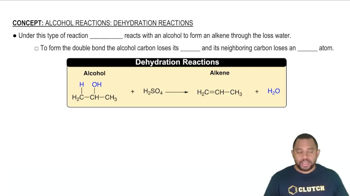
Alcohol Reactions: Dehydration Reactions Concept 1