Ch.21 The Generation of Biochemical Energy
McMurry - Fundamentals of General, Organic, and Biological Chemistry 8th Edition
McMurry8th EditionFundamentals of General, Organic, and Biological ChemistryISBN: 9780134015187당신이 사용하는 게 아니라요?교과서 변경
21장, 문제 29

Why is ∆G a useful quantity for predicting the favorability of biochemical reactions?

검증된 단계별 안내
1
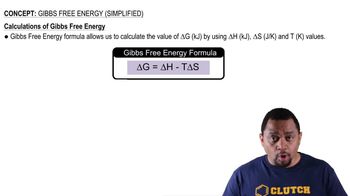
Understand that ∆G, or Gibbs free energy change, is a thermodynamic quantity that combines enthalpy (∆H), entropy (∆S), and temperature (T) to determine the spontaneity of a reaction. The formula is: ΔG=ΔH-TΔS.
Recognize that a negative ∆G value indicates a spontaneous reaction under the given conditions, meaning the reaction is thermodynamically favorable and can proceed without external energy input.
Note that ∆G provides insight into both the energy changes (enthalpy) and the disorder (entropy) of a system, making it particularly useful for understanding complex biochemical reactions where both factors are important.
Understand that in biochemical systems, ∆G can predict whether a reaction will occur under physiological conditions, which is critical for processes like metabolism, enzyme activity, and energy transfer.
Realize that ∆G also helps in determining equilibrium positions and the extent to which a reaction will proceed, which is essential for understanding reaction dynamics in living organisms.

비슷한 문제에 대한 검증된 영상 답변:

이 영상 해법은 위 문제에 도움이 된다고 튜터들이 추천한 것입니다.
영상 길이:
3m
도움이 되었나요?

주요 개념

질문에 올바르게 답하기 위해 반드시 이해해야 하는 핵심 개념들은 다음과 같습니다.

Gibbs Free Energy (∆G)

Gibbs Free Energy (∆G) is a thermodynamic potential that measures the maximum reversible work obtainable from a thermodynamic system at constant temperature and pressure. It is a crucial indicator of the spontaneity of a reaction; a negative ∆G value suggests that a reaction can occur spontaneously, while a positive value indicates that the reaction is non-spontaneous under standard conditions.
추천 영상:
가이드 코스
01:04
Gibbs Free Energy (Simplified) Concept 3

Spontaneity of Reactions

The spontaneity of a reaction refers to its tendency to proceed without external influence. This is determined by the sign of ∆G: reactions with a negative ∆G are spontaneous, meaning they can occur naturally, while those with a positive ∆G require energy input to proceed. Understanding spontaneity helps predict whether a biochemical reaction will occur in living organisms.
추천 영상:
가이드 코스
06:17
Spontaneous Reaction Concept 1

Thermodynamic Equilibrium

Thermodynamic equilibrium is the state in which a system's macroscopic properties remain constant over time, indicating that the forward and reverse reactions occur at equal rates. At equilibrium, ∆G equals zero, meaning there is no net change in the concentrations of reactants and products. This concept is essential for understanding how biochemical reactions can shift in response to changes in conditions, such as concentration and temperature.
추천 영상:
가이드 코스
01:18
First Law of Thermodynamics