Ch.23 Lipids
McMurry - Fundamentals of General, Organic, and Biological Chemistry 8th Edition
McMurry8th EditionFundamentals of General, Organic, and Biological ChemistryISBN: 9780134015187당신이 사용하는 게 아니라요?교과서 변경
23장, 문제 82

Draw cholesterol acetate. Is this molecule saponifiable? Explain.

검증된 단계별 안내
1
Step 1: Understand the structure of cholesterol acetate. Cholesterol acetate is a derivative of cholesterol where the hydroxyl group (-OH) on the cholesterol molecule is replaced with an acetate group (-OCOCH3). Begin by drawing the structure of cholesterol, which is a steroid with a characteristic four-ring structure (three six-membered rings and one five-membered ring) and a hydroxyl group at the C3 position.
Step 2: Modify the cholesterol structure to form cholesterol acetate. Replace the hydroxyl group (-OH) at the C3 position with an acetate group (-OCOCH3). This involves attaching a carbonyl group (C=O) and a methyl group (-CH3) to the oxygen atom.
Step 3: Determine if cholesterol acetate is saponifiable. A molecule is considered saponifiable if it contains an ester functional group, which can undergo hydrolysis in the presence of a strong base (e.g., NaOH) to produce an alcohol and a carboxylate salt.
Step 4: Identify the ester group in cholesterol acetate. The acetate group (-OCOCH3) attached to the cholesterol backbone contains an ester bond (R-COOR'). This confirms that cholesterol acetate is saponifiable because the ester bond can be broken during saponification.
Step 5: Conclude that cholesterol acetate is saponifiable and explain why. The presence of the ester functional group in cholesterol acetate allows it to undergo hydrolysis in basic conditions, producing cholesterol (an alcohol) and acetate (a carboxylate salt).

비슷한 문제에 대한 검증된 영상 답변:

이 영상 해법은 위 문제에 도움이 된다고 튜터들이 추천한 것입니다.
영상 길이:
3m
도움이 되었나요?

주요 개념

질문에 올바르게 답하기 위해 반드시 이해해야 하는 핵심 개념들은 다음과 같습니다.

Cholesterol Acetate Structure

Cholesterol acetate is an ester formed from cholesterol and acetic acid. It consists of a cholesterol backbone, which is a sterol with a complex ring structure, and an acetate group attached via an ester bond. Understanding its molecular structure is crucial for analyzing its chemical properties and behavior in biological systems.
추천 영상:
가이드 코스
2:17
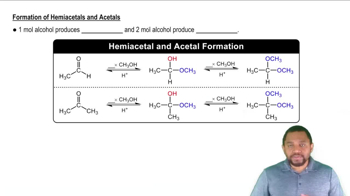
Formation of Hemiacetals and Acetals Concept 2

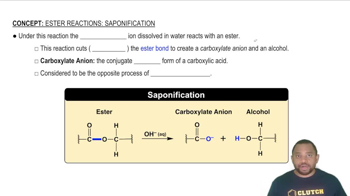
Saponification

Saponification is the chemical reaction that occurs when a fat or oil reacts with a strong base, typically resulting in the formation of glycerol and soap. This process involves the hydrolysis of esters, which means that for a molecule to be saponifiable, it must contain ester bonds that can be broken down by the base. Recognizing whether cholesterol acetate can undergo this reaction is essential for answering the question.
추천 영상:
가이드 코스
1:25
Ester Reactions: Saponification Concept 1

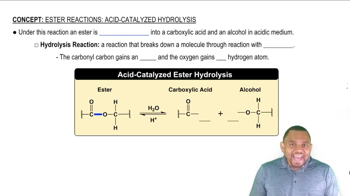
Ester Bonds and Hydrolysis

Ester bonds are formed between an alcohol and a carboxylic acid, and they can be hydrolyzed in the presence of water and a catalyst, such as a base. In the context of cholesterol acetate, understanding how these bonds behave during hydrolysis helps determine if the molecule can be saponified. If the ester bond can be broken, the molecule is considered saponifiable.
추천 영상:
가이드 코스
1:14
Acid-Catalyzed Ester Hydrolysis Concept 1