Ch.23 Lipids
McMurry - Fundamentals of General, Organic, and Biological Chemistry 8th Edition
McMurry8th EditionFundamentals of General, Organic, and Biological ChemistryISBN: 9780134015187당신이 사용하는 게 아니라요?교과서 변경
23장, 문제 39

There are two isomeric triacylglycerol molecules whose components are glycerol, one palmitic acid unit, and two stearic acid units. Draw the structures of both, and explain how they differ.

검증된 단계별 안내
1
Understand the structure of a triacylglycerol molecule: It consists of a glycerol backbone (a three-carbon molecule with hydroxyl groups on each carbon) esterified with three fatty acid chains. In this case, the fatty acids are one palmitic acid (16:0) and two stearic acids (18:0).
Recognize that isomers of triacylglycerols arise from the different possible arrangements of the fatty acid chains on the three hydroxyl groups of the glycerol backbone. Since there are two stearic acid units and one palmitic acid unit, the arrangement of these fatty acids will determine the isomers.
Draw the first isomer: Attach the palmitic acid to the first hydroxyl group of glycerol and the two stearic acids to the second and third hydroxyl groups. This arrangement is one possible structural isomer.
Draw the second isomer: Attach one stearic acid to the first hydroxyl group, the palmitic acid to the second hydroxyl group, and the second stearic acid to the third hydroxyl group. This is the second possible structural isomer.
Explain the difference: The two isomers differ in the positional arrangement of the palmitic acid and stearic acids on the glycerol backbone. This positional difference affects the physical and chemical properties of the triacylglycerol, such as melting point and solubility.

비슷한 문제에 대한 검증된 영상 답변:

이 영상 해법은 위 문제에 도움이 된다고 튜터들이 추천한 것입니다.
영상 길이:
5m
도움이 되었나요?

주요 개념

질문에 올바르게 답하기 위해 반드시 이해해야 하는 핵심 개념들은 다음과 같습니다.

Triacylglycerol Structure

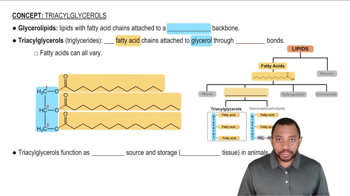
Triacylglycerols, or triglycerides, are esters formed from glycerol and three fatty acids. In this case, the glycerol backbone is attached to two stearic acid molecules and one palmitic acid molecule. The arrangement of these fatty acids can vary, leading to different isomers, which are crucial for understanding the structural differences in the molecules.
추천 영상:
가이드 코스
1:52
Triacylglycerols Concept 1

Isomerism

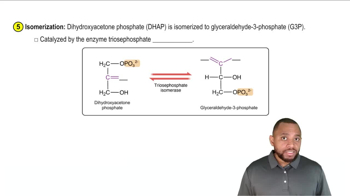
Isomerism refers to the phenomenon where two or more compounds have the same molecular formula but different structural arrangements. In the context of triacylglycerols, the isomers can differ in the positioning of the fatty acid chains on the glycerol backbone, which affects their physical and chemical properties, such as melting point and solubility.
추천 영상:
가이드 코스
1:26
Glycolysis Concept 5

Fatty Acid Composition

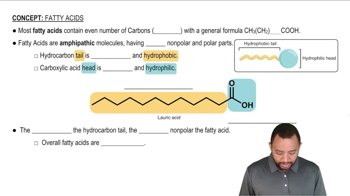
Fatty acids are long hydrocarbon chains that can be saturated or unsaturated. Palmitic acid is a saturated fatty acid with a 16-carbon chain, while stearic acid is a saturated fatty acid with an 18-carbon chain. The specific combination and arrangement of these fatty acids in triacylglycerols influence their biological functions and nutritional properties.
추천 영상:
가이드 코스
2:00
Fatty Acids Concept 1