Ch.24 Lipid Metabolism
McMurry - Fundamentals of General, Organic, and Biological Chemistry 8th Edition
McMurry8th EditionFundamentals of General, Organic, and Biological ChemistryISBN: 9780134015187당신이 사용하는 게 아니라요?교과서 변경
24장, 문제 10

Starting with acetyl-S-enzyme-1 and malonyl-CoA, how many molecules of acetyl-CoA are needed to synthesize an 18-carbon fatty acid (C18:0)? How many molecules of CO2 are released in this process?

검증된 단계별 안내
1
Step 1: Understand the process of fatty acid synthesis. Fatty acid synthesis involves the sequential addition of 2-carbon units (from acetyl-CoA) to a growing fatty acid chain. The initial step uses acetyl-S-enzyme-1 as the starting molecule, and subsequent elongation steps use malonyl-CoA as the 2-carbon donor.
Step 2: Determine the number of 2-carbon units required to synthesize an 18-carbon fatty acid. Since the fatty acid starts with 2 carbons from acetyl-S-enzyme-1, the remaining 16 carbons must come from additional acetyl-CoA molecules via malonyl-CoA.
Step 3: Calculate the number of malonyl-CoA molecules needed. Each malonyl-CoA contributes 2 carbons to the fatty acid chain. To add 16 carbons, 8 malonyl-CoA molecules are required.
Step 4: Account for the acetyl-CoA molecules used to form malonyl-CoA. Each malonyl-CoA is synthesized from one acetyl-CoA, so 8 acetyl-CoA molecules are needed to produce the 8 malonyl-CoA molecules.
Step 5: Determine the total number of acetyl-CoA molecules and CO₂ released. One acetyl-CoA is used to start the chain, and 8 more are used to form malonyl-CoA, making a total of 9 acetyl-CoA molecules. Additionally, each malonyl-CoA formation releases one CO₂, so 8 CO₂ molecules are released in the process.

비슷한 문제에 대한 검증된 영상 답변:

이 영상 해법은 위 문제에 도움이 된다고 튜터들이 추천한 것입니다.
영상 길이:
3m

주요 개념

질문에 올바르게 답하기 위해 반드시 이해해야 하는 핵심 개념들은 다음과 같습니다.

Fatty Acid Synthesis

Fatty acid synthesis is a metabolic process that constructs fatty acids from acetyl-CoA and malonyl-CoA through a series of enzymatic reactions. Each cycle of the synthesis adds two carbon atoms to the growing fatty acid chain, utilizing malonyl-CoA as a carbon donor. For an 18-carbon fatty acid, multiple cycles are required, and understanding this process is crucial for determining the number of acetyl-CoA molecules needed.
추천 영상:
가이드 코스
2:00
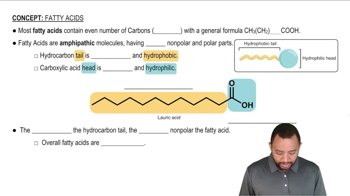
Fatty Acids Concept 1

Acetyl-CoA and Malonyl-CoA

Acetyl-CoA is a central metabolite in energy production and biosynthesis, serving as the building block for fatty acid synthesis. Malonyl-CoA, derived from acetyl-CoA, is used in the elongation of the fatty acid chain. The interplay between these two molecules is essential for understanding how many acetyl-CoA units are required to produce a specific length of fatty acid.
추천 영상:
가이드 코스
1:33
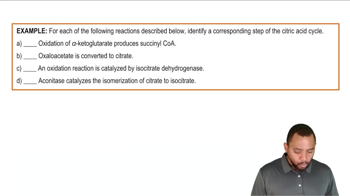
Phase B - Succinyl CoA Formation Example 2

Decarboxylation and CO₂ Release

During fatty acid synthesis, decarboxylation reactions occur, where carbon dioxide (CO₂) is released as a byproduct. Each cycle of adding two carbons from malonyl-CoA results in the release of one molecule of CO₂. Understanding the stoichiometry of these reactions is important for calculating the total CO₂ released when synthesizing an 18-carbon fatty acid.
추천 영상:
가이드 코스
2:21
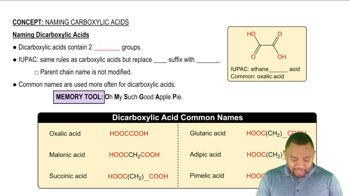
Naming Dicarboxylic Acids Concept 3