Ch.26 Nucleic Acids and Protein Synthesis
McMurry - Fundamentals of General, Organic, and Biological Chemistry 8th Edition
McMurry8th EditionFundamentals of General, Organic, and Biological ChemistryISBN: 9780134015187당신이 사용하는 게 아니라요?교과서 변경
26장, 문제 24a

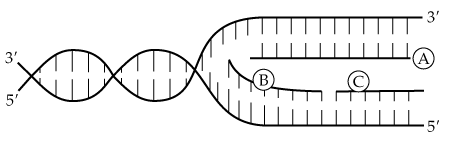
Copy the following simplified drawing of a DNA replication fork:

a. On the drawing, indicate the direction of synthesis of the new strand labeled A and the location of DNA polymerase on the strand.

검증된 단계별 안내
1
Understand the structure of a DNA replication fork: A replication fork is the Y-shaped region where the DNA double helix is unwound to allow replication. It consists of a leading strand (synthesized continuously) and a lagging strand (synthesized in fragments).
Identify the direction of DNA synthesis: DNA polymerase synthesizes new DNA strands in the 5' to 3' direction. This means that the new strand labeled A will be synthesized in the 5' to 3' direction relative to its template strand.
Determine the location of DNA polymerase: DNA polymerase is the enzyme responsible for adding nucleotides to the growing DNA strand. On the leading strand, it moves continuously toward the replication fork, while on the lagging strand, it synthesizes short Okazaki fragments away from the fork.
Label the direction of synthesis on the drawing: On the strand labeled A, mark the 5' and 3' ends of the new strand and draw an arrow indicating the direction of synthesis (5' to 3').
Indicate the position of DNA polymerase: On the drawing, place DNA polymerase at the point where it is actively adding nucleotides to the new strand labeled A, ensuring it aligns with the 5' to 3' synthesis direction.

비슷한 문제에 대한 검증된 영상 답변:

이 영상 해법은 위 문제에 도움이 된다고 튜터들이 추천한 것입니다.
영상 길이:
6m
도움이 되었나요?

주요 개념

질문에 올바르게 답하기 위해 반드시 이해해야 하는 핵심 개념들은 다음과 같습니다.

DNA Replication Fork

The DNA replication fork is a Y-shaped structure that forms during DNA replication, where the double helix unwinds and separates into two single strands. This fork is crucial for the synthesis of new DNA strands, as it provides the template for the replication process. Understanding the orientation of the fork is essential for identifying the direction of strand synthesis.
추천 영상:
가이드 코스
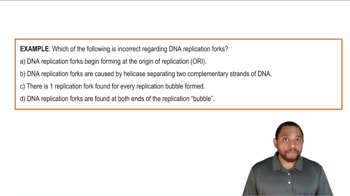
1:40
Intro to DNA Replication Example 2

Direction of Synthesis

DNA synthesis occurs in a specific direction, from the 5' to the 3' end of the new strand. This means that nucleotides are added to the 3' end of the growing strand, which is critical for the proper replication of DNA. Recognizing this directionality helps in determining how new strands are formed at the replication fork.
추천 영상:
가이드 코스
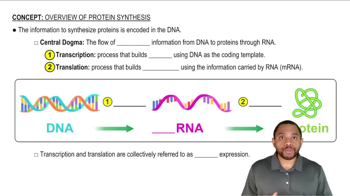
1:54
Overview of Protein Synthesis Concept 1

DNA Polymerase

DNA polymerase is the enzyme responsible for synthesizing new DNA strands by adding nucleotides complementary to the template strand. It plays a vital role at the replication fork, where it binds to the template strand and catalyzes the formation of the new strand. Understanding the function and location of DNA polymerase is key to grasping the mechanics of DNA replication.
추천 영상:
가이드 코스
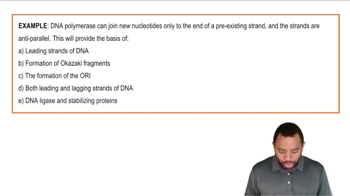
1:31
Steps of DNA Replication Example 1