Ch.26 Nucleic Acids and Protein Synthesis
McMurry - Fundamentals of General, Organic, and Biological Chemistry 8th Edition
McMurry8th EditionFundamentals of General, Organic, and Biological ChemistryISBN: 9780134015187당신이 사용하는 게 아니라요?교과서 변경
26장, 문제 32a

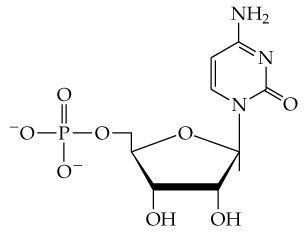
For the following molecule:

a. Label the three nucleic acid building blocks it contains.

검증된 단계별 안내
1
Identify the three main components of a nucleic acid building block: (1) a phosphate group, (2) a sugar (either ribose or deoxyribose), and (3) a nitrogenous base (adenine, thymine, cytosine, guanine, or uracil).
Examine the molecular structure in the image provided. Locate the phosphate group, which is typically represented as a phosphorus atom bonded to four oxygen atoms.
Next, identify the sugar molecule. Look for a five-carbon ring structure (pentose sugar). Determine whether it is ribose (with an -OH group on the 2' carbon) or deoxyribose (with an -H on the 2' carbon).
Locate the nitrogenous base attached to the sugar. It will be a ring structure containing nitrogen atoms. Classify it as a purine (adenine or guanine, which have two rings) or a pyrimidine (cytosine, thymine, or uracil, which have one ring).
Label each of the three components (phosphate group, sugar, and nitrogenous base) on the molecule in the image. Ensure that all three nucleic acid building blocks are clearly identified and labeled.

비슷한 문제에 대한 검증된 영상 답변:

이 영상 해법은 위 문제에 도움이 된다고 튜터들이 추천한 것입니다.
영상 길이:
1m
도움이 되었나요?

주요 개념

질문에 올바르게 답하기 위해 반드시 이해해야 하는 핵심 개념들은 다음과 같습니다.

Nucleotides

Nucleotides are the basic building blocks of nucleic acids, consisting of three components: a phosphate group, a five-carbon sugar, and a nitrogenous base. They link together to form the backbone of DNA and RNA, with the sequence of nitrogenous bases encoding genetic information.
추천 영상:
가이드 코스
1:21
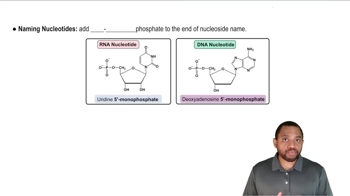
Naming Nucleosides and Nucleotides Concept 2

Nitrogenous Bases

Nitrogenous bases are organic molecules that contain nitrogen and are a key part of nucleotides. In DNA, the bases are adenine (A), thymine (T), cytosine (C), and guanine (G), while in RNA, uracil (U) replaces thymine. The specific pairing of these bases (A with T, and C with G) is crucial for the structure and function of nucleic acids.
추천 영상:
가이드 코스
1:23
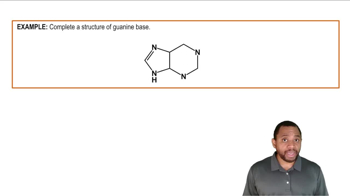
Nitrogenous Bases Example 3

Phosphodiester Bond

Phosphodiester bonds are the covalent linkages that connect the phosphate group of one nucleotide to the sugar of another, forming the sugar-phosphate backbone of nucleic acids. This bond is essential for the stability and integrity of the nucleic acid structure, allowing for the formation of long chains that carry genetic information.
추천 영상:
가이드 코스
2:19
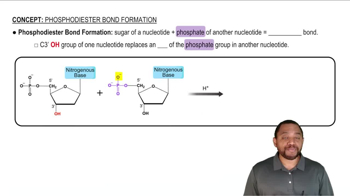
Phosphodiester Bond Formation Concept 1