Ch.26 Nucleic Acids and Protein Synthesis
McMurry - Fundamentals of General, Organic, and Biological Chemistry 8th Edition
McMurry8th EditionFundamentals of General, Organic, and Biological ChemistryISBN: 9780134015187당신이 사용하는 게 아니라요?교과서 변경
26장, 문제 74

Suppose that 22% of the nucleotides of a DNA molecule are deoxyadenosine and during replication the relative amounts of available deoxynucleoside triphosphates are 22% dATP, 22% dCTP, 28% dGTP, and 28% dTTP. What deoxynucleoside triphosphate is limiting to the replication? Explain.

검증된 단계별 안내
1
Step 1: Understand the problem. DNA replication requires complementary base pairing. Adenine (A) pairs with Thymine (T), and Cytosine (C) pairs with Guanine (G). The problem asks us to determine which deoxynucleoside triphosphate (dNTP) is limiting during replication based on the given percentages of nucleotides in the DNA and the available dNTPs.
Step 2: Analyze the DNA composition. The problem states that 22% of the nucleotides in the DNA are deoxyadenosine (A). Since DNA is double-stranded and complementary, the percentage of thymine (T) must also be 22%. Similarly, the remaining 56% of the DNA is split equally between cytosine (C) and guanine (G), meaning each is 28%.
Step 3: Compare the DNA composition to the available dNTPs. The available dNTPs are provided as 22% dATP (for A), 22% dTTP (for T), 28% dGTP (for G), and 28% dCTP (for C). These percentages match the DNA composition exactly, so at first glance, it seems there is no limiting dNTP.
Step 4: Consider the pairing requirements during replication. For every adenine (A) in the DNA, a thymine (T) is required from the dTTP pool, and vice versa. Similarly, for every cytosine (C), a guanine (G) is required, and vice versa. This means the availability of dNTPs must be sufficient to match the complementary base pairing demands.
Step 5: Identify the limiting dNTP. Since the percentages of available dNTPs match the DNA composition exactly, no single dNTP is limiting under these conditions. However, if the replication process were to deviate from these exact proportions (e.g., due to experimental error or unequal consumption), the dNTP with the lowest percentage relative to its demand (in this case, dATP or dTTP at 22%) would become limiting.

비슷한 문제에 대한 검증된 영상 답변:

이 영상 해법은 위 문제에 도움이 된다고 튜터들이 추천한 것입니다.
영상 길이:
3m
도움이 되었나요?

주요 개념

질문에 올바르게 답하기 위해 반드시 이해해야 하는 핵심 개념들은 다음과 같습니다.

Nucleotide Composition

Nucleotide composition refers to the relative abundance of the four types of nucleotides in a DNA molecule: adenine (A), cytosine (C), guanine (G), and thymine (T). In this context, understanding that 22% of the nucleotides are deoxyadenosine (A) is crucial for determining which deoxynucleoside triphosphate (dNTP) is limiting during DNA replication.
추천 영상:
가이드 코스
1:21
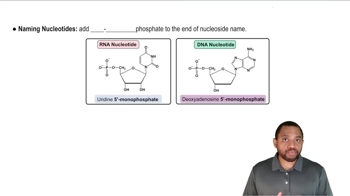
Naming Nucleosides and Nucleotides Concept 2

Deoxynucleoside Triphosphates (dNTPs)

Deoxynucleoside triphosphates (dNTPs) are the building blocks of DNA, consisting of a deoxyribose sugar, a phosphate group, and a nitrogenous base (A, C, G, or T). The availability of these dNTPs during DNA replication is essential, as they must be present in sufficient quantities for the synthesis of new DNA strands. The relative proportions of dATP, dCTP, dGTP, and dTTP influence which dNTP may become limiting.
추천 영상:
가이드 코스
1:03
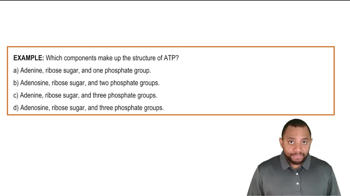
Adenosine Triphosphate (ATP) Example 2

Limiting Reagent

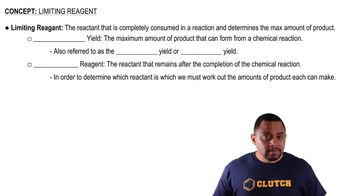
In biochemical reactions, a limiting reagent is the substance that is consumed first and thus limits the extent of the reaction. In the context of DNA replication, the dNTP that is present in the lowest relative amount compared to the required nucleotide composition will be the limiting factor, affecting the overall rate and completion of DNA synthesis.
추천 영상:
가이드 코스
01:30
Limiting Reagent