Ch.26 Nucleic Acids and Protein Synthesis
McMurry - Fundamentals of General, Organic, and Biological Chemistry 8th Edition
McMurry8th EditionFundamentals of General, Organic, and Biological ChemistryISBN: 9780134015187당신이 사용하는 게 아니라요?교과서 변경
26장, 문제 38

What is the difference between the 3′ end and the 5′ end of a polynucleotide?

검증된 단계별 안내
1
Understand that a polynucleotide is a chain of nucleotides, which are the building blocks of nucleic acids like DNA and RNA. Each nucleotide consists of three components: a phosphate group, a sugar (deoxyribose in DNA or ribose in RNA), and a nitrogenous base.
Recognize that the terms '3′ end' and '5′ end' refer to the orientation of the sugar-phosphate backbone of the polynucleotide. These numbers correspond to the carbon atoms in the sugar molecule of the nucleotide.
At the 5′ end of the polynucleotide, the phosphate group is attached to the 5′ carbon of the sugar. This end is often referred to as the 'phosphate end' because it terminates with a free phosphate group.
At the 3′ end of the polynucleotide, the hydroxyl group (-OH) is attached to the 3′ carbon of the sugar. This end is often referred to as the 'hydroxyl end' because it terminates with a free hydroxyl group.
The difference in the 3′ and 5′ ends is crucial for the directionality of nucleic acids, which determines how enzymes like DNA polymerase and RNA polymerase synthesize new strands. Nucleic acids are synthesized in the 5′ to 3′ direction, meaning new nucleotides are added to the 3′ end of the growing chain.

비슷한 문제에 대한 검증된 영상 답변:

이 영상 해법은 위 문제에 도움이 된다고 튜터들이 추천한 것입니다.
영상 길이:
2m
도움이 되었나요?

주요 개념

질문에 올바르게 답하기 위해 반드시 이해해야 하는 핵심 개념들은 다음과 같습니다.

Polynucleotide Structure

Polynucleotides, such as DNA and RNA, are long chains of nucleotides linked by phosphodiester bonds. Each nucleotide consists of a sugar, a phosphate group, and a nitrogenous base. The sequence and orientation of these nucleotides determine the polynucleotide's function and properties.
추천 영상:
가이드 코스
1:01
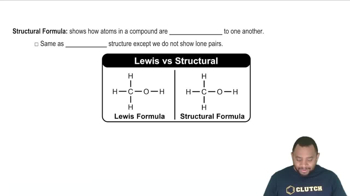
Structural Formula Concept 2

5′ and 3′ Ends

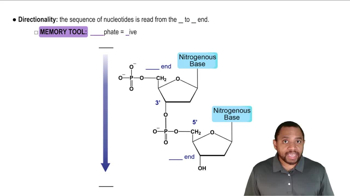
The 5′ end of a polynucleotide refers to the terminal end that has a free phosphate group attached to the fifth carbon of the sugar molecule. Conversely, the 3′ end has a free hydroxyl group attached to the third carbon of the sugar. This directional difference is crucial for processes like DNA replication and transcription.
추천 영상:
가이드 코스
1:43
Primary Structure of Nucleic Acids Concept 2

Directionality in Nucleic Acids

Directionality in nucleic acids refers to the orientation of the polynucleotide strand, which is always synthesized in the 5′ to 3′ direction. This means that new nucleotides are added to the 3′ end of the growing strand. Understanding this concept is essential for grasping how enzymes interact with DNA and RNA during replication and transcription.
추천 영상:
가이드 코스
0:56
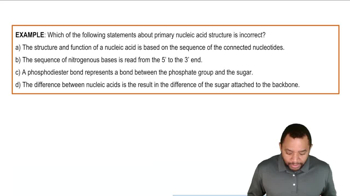
Primary Structure of Nucleic Acids Example 2