Ch. 1 - Remembering General Chemistry: Electronic Structure and Bonding
Bruice - Organic Chemistry 8th Edition
Bruice8th EditionOrganic ChemistryISBN: 9780135213711당신이 사용하는 게 아니라요?교과서 변경
1장, 문제 15c,d

An atom with a formal charge does not necessarily have more or less electron density than the atoms in the molecule without formal charges. We can see this by examining the potential maps for H2O, H3O+, and HO.
<IMAGE>
c. Which atom bears the formal positive charge in the hydronium ion?
d. Which atom has the least electron density in the hydronium ion?

검증된 단계별 안내
1
Step 1: Understand the hydronium ion (H3O+). It consists of one oxygen atom bonded to three hydrogen atoms, with a formal positive charge distributed across the molecule.
Step 2: To determine which atom bears the formal positive charge in H3O+, recall that the formal charge is typically assigned to the atom that has fewer electrons than its neutral state. In H3O+, the oxygen atom has a formal positive charge because it has one less lone pair compared to neutral water (H2O).
Step 3: To identify the atom with the least electron density in H3O+, consider the electronegativity of the atoms. Oxygen is more electronegative than hydrogen, so it pulls electron density toward itself. However, the formal positive charge on oxygen reduces its electron density compared to neutral oxygen in H2O.
Step 4: Examine the molecular potential map for H3O+ (if provided). The atom with the least electron density will appear in the region with the most positive potential (blue regions in potential maps). This corresponds to the oxygen atom in H3O+.
Step 5: Summarize: In H3O+, the oxygen atom bears the formal positive charge and has the least electron density due to its formal charge and electronegativity effects.

비슷한 문제에 대한 검증된 영상 답변:

이 영상 해법은 위 문제에 도움이 된다고 튜터들이 추천한 것입니다.
영상 길이:
5m
도움이 되었나요?

주요 개념

질문에 올바르게 답하기 위해 반드시 이해해야 하는 핵심 개념들은 다음과 같습니다.

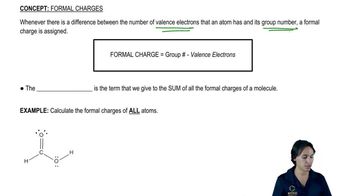
Formal Charge

Formal charge is a theoretical charge assigned to an atom in a molecule, calculated based on the number of valence electrons, the number of bonds, and the number of non-bonding electrons. It helps in understanding the distribution of electrons within a molecule and predicting the stability of different resonance structures. A formal charge does not necessarily correlate with the actual electron density around an atom.
추천 영상:
가이드 코스
01:34
Calculating formal and net charge.

Electron Density

Electron density refers to the probability of finding electrons in a given region of space around an atom or molecule. It is visualized using potential maps, where areas of high electron density are often represented in blue, indicating regions where electrons are more likely to be found. Understanding electron density is crucial for predicting molecular behavior, reactivity, and the distribution of charges within a molecule.
추천 영상:
가이드 코스
03:54
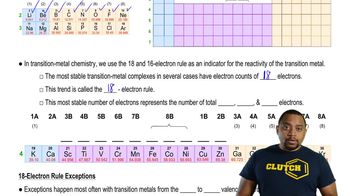
The 18 and 16 Electron Rule

Hydronium Ion (H3O+)

The hydronium ion (H3O+) is formed when a water molecule (H2O) accepts a proton (H+). In this ion, the oxygen atom carries a formal positive charge due to the addition of the proton, which alters the electron density around it. Analyzing the electron density in H3O+ compared to neutral water helps illustrate how formal charges can affect molecular properties without necessarily changing the overall electron density distribution.
추천 영상:
3:39
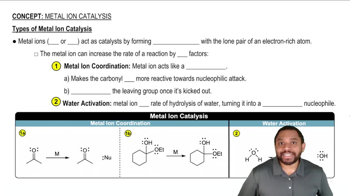
Metal Ion Catalysis Concept 1