Ch. 10 - Reactions of Alcohols, Ethers, Epoxides, Amines, and Sulfur-Containing Compounds
Bruice - Organic Chemistry 8th Edition
Bruice8th EditionOrganic ChemistryISBN: 9780135213711당신이 사용하는 게 아니라요?교과서 변경
10장, 문제 93a

Although 2-methyl-1,2-propanediol is an unsymmetrical vicinal diol, only one product is obtained when it is dehydrated in an acidic solution.
a. What is this product?

검증된 단계별 안내
1
Step 1: Begin by identifying the structure of 2-methyl-1,2-propanediol. It is a vicinal diol, meaning the hydroxyl (-OH) groups are on adjacent carbon atoms. The molecule has a methyl group attached to the second carbon.
Step 2: Understand the dehydration reaction mechanism in acidic conditions. Dehydration involves the removal of water (H₂O) from the molecule, typically facilitated by an acid catalyst like H₂SO₄ or H₃PO₄.
Step 3: Analyze the protonation step. In acidic conditions, one of the hydroxyl groups is protonated, forming a good leaving group (water). This step is crucial for initiating the reaction.
Step 4: Consider the carbocation intermediate formed after the departure of water. The stability of the carbocation is key to determining the product. In this case, the molecule forms a tertiary carbocation (most stable) due to the methyl group on the second carbon.
Step 5: Examine the final step, where a double bond is formed through elimination of a proton from an adjacent carbon atom. This results in the formation of an alkene. The product is 2-methylpropene, as it is the most stable alkene formed under these conditions.

비슷한 문제에 대한 검증된 영상 답변:

이 영상 해법은 위 문제에 도움이 된다고 튜터들이 추천한 것입니다.
영상 길이:
6m

주요 개념

질문에 올바르게 답하기 위해 반드시 이해해야 하는 핵심 개념들은 다음과 같습니다.

Vicinal Diols

Vicinal diols, also known as glycols, are organic compounds that contain two hydroxyl (-OH) groups attached to adjacent carbon atoms. In the case of 2-methyl-1,2-propanediol, the presence of these two -OH groups allows for potential dehydration reactions, where water is eliminated to form alkenes. Understanding the structure and reactivity of vicinal diols is crucial for predicting the products of their dehydration.
추천 영상:
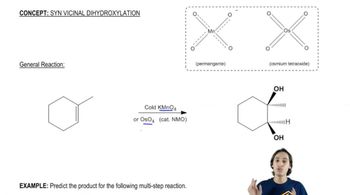
03:50
General properties of syn vicinal dihydroxylation.

Dehydration Reaction

A dehydration reaction involves the removal of water from a compound, often resulting in the formation of a double bond. In acidic conditions, the hydroxyl groups of vicinal diols can be protonated, leading to the formation of a more stable carbocation intermediate. This process is essential for understanding how 2-methyl-1,2-propanediol can yield a single product upon dehydration, despite its unsymmetrical nature.
추천 영상:
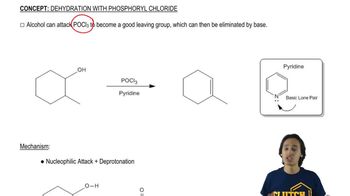
01:23
General Reaction of Dehydration with POCl3

Carbocation Stability

Carbocation stability is a key factor in determining the outcome of dehydration reactions. Tertiary carbocations are more stable than secondary or primary ones due to hyperconjugation and inductive effects from surrounding alkyl groups. In the case of 2-methyl-1,2-propanediol, the dehydration leads to the formation of a stable tertiary carbocation, which ultimately results in the formation of a single alkene product, illustrating the influence of carbocation stability on reaction pathways.
추천 영상:
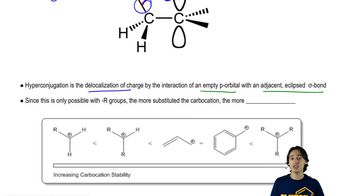
05:58
Determining Carbocation Stability