Ch. 10 - Reactions of Alcohols, Ethers, Epoxides, Amines, and Sulfur-Containing Compounds
Bruice - Organic Chemistry 8th Edition
Bruice8th EditionOrganic ChemistryISBN: 9780135213711당신이 사용하는 게 아니라요?교과서 변경
10장, 문제 56c

Indicate which alcohol in each pair undergoes an elimination reaction more rapidly when heated with H2SO4.
c.

검증된 단계별 안내
1
Identify the structure of each alcohol in the pair. Look for the classification of each alcohol as primary, secondary, or tertiary based on the carbon atom to which the hydroxyl group (-OH) is attached.
Recall that the rate of elimination reactions, such as dehydration, generally increases with the degree of substitution of the alcohol. Tertiary alcohols typically undergo elimination more rapidly than secondary or primary alcohols.
Consider the mechanism of the elimination reaction. In the presence of a strong acid like H2SO4, alcohols undergo dehydration to form alkenes. This process often follows an E1 mechanism, especially for secondary and tertiary alcohols, where the formation of a stable carbocation intermediate is favored.
Evaluate the stability of the potential carbocation intermediates that would form from each alcohol. More substituted carbocations (tertiary > secondary > primary) are more stable and thus form more readily, leading to faster elimination reactions.
Compare the alcohols in the pair based on their structure and the stability of the carbocation intermediates they would form. The alcohol that forms the more stable carbocation will undergo the elimination reaction more rapidly when heated with H2SO4.

비슷한 문제에 대한 검증된 영상 답변:

이 영상 해법은 위 문제에 도움이 된다고 튜터들이 추천한 것입니다.
영상 길이:
3m
도움이 되었나요?

주요 개념

질문에 올바르게 답하기 위해 반드시 이해해야 하는 핵심 개념들은 다음과 같습니다.

Elimination Reactions

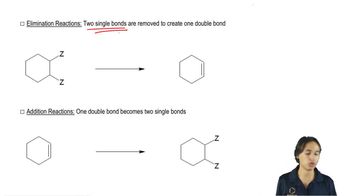
Elimination reactions involve the removal of a small molecule from a larger one, typically resulting in the formation of a double bond. In organic chemistry, these reactions often occur with alcohols when treated with strong acids, leading to the formation of alkenes. The mechanism can follow either an E1 or E2 pathway, depending on the substrate and conditions.
추천 영상:
00:40
Recognizing Elimination Reactions.

Alcohol Structure and Stability

The structure of the alcohol, particularly the degree of substitution at the carbon bearing the hydroxyl group, significantly influences its reactivity in elimination reactions. Tertiary alcohols are generally more reactive than secondary or primary alcohols due to greater carbocation stability formed during the E1 mechanism, or better leaving group ability in E2 reactions.
추천 영상:
03:43
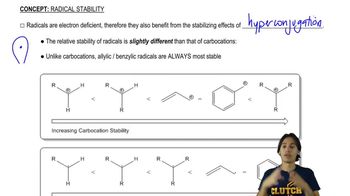
The radical stability trend.

Role of H2SO4 in Dehydration

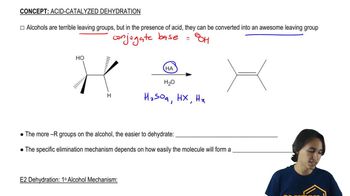
Sulfuric acid (H2SO4) acts as a strong acid and dehydrating agent in elimination reactions involving alcohols. It protonates the hydroxyl group, converting it into a better leaving group, and facilitates the removal of water. The heat applied during the reaction promotes the elimination process, favoring the formation of alkenes from the alcohols.
추천 영상:
06:01
General features of acid-catalyzed dehydration.