Ch. 10 - Reactions of Alcohols, Ethers, Epoxides, Amines, and Sulfur-Containing Compounds
Bruice - Organic Chemistry 8th Edition
Bruice8th EditionOrganic ChemistryISBN: 9780135213711당신이 사용하는 게 아니라요?교과서 변경
10장, 문제 36a

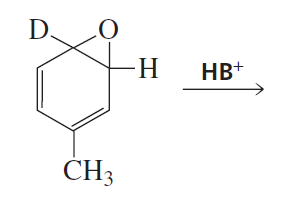
The existence of the NIH shift was established by determining the major product obtained from rearrangement of the following arene oxide, in which a hydrogen has been replaced by a deuterium.
a. What would be the major product if the NIH shift occurs? (Hint: A C—H bond is easier to break than a C—D bond.)
Arene oxide structure showing deuterium and hydrogen, with a proton transfer indicated by HB+.

검증된 단계별 안내
1
Step 1: Analyze the structure of the arene oxide provided in the image. The molecule contains a deuterium (D) atom and a hydrogen (H) atom attached to the same carbon adjacent to the epoxide group. The epoxide group is highly reactive and prone to rearrangement under acidic conditions (HB⁺).
Step 2: Understand the NIH shift mechanism. The NIH shift involves the migration of a hydrogen (or deuterium) atom during the rearrangement of the arene oxide. This occurs due to the breaking of the C-H or C-D bond and subsequent reattachment to a neighboring carbon atom.
Step 3: Consider the bond strength of C-H versus C-D. The C-H bond is easier to break than the C-D bond because the C-D bond is stronger due to the heavier mass of deuterium. This means the hydrogen atom is more likely to migrate during the NIH shift.
Step 4: Predict the rearrangement product. During the NIH shift, the hydrogen atom (H) migrates to the neighboring carbon atom, while the deuterium (D) remains in its original position. This results in the formation of a rearranged product where the hydrogen is now attached to a different carbon.
Step 5: Verify the major product. The major product will have the hydrogen atom relocated to the neighboring carbon, while the deuterium remains unchanged. This rearrangement stabilizes the molecule and completes the NIH shift process.

비슷한 문제에 대한 검증된 영상 답변:

이 영상 해법은 위 문제에 도움이 된다고 튜터들이 추천한 것입니다.
영상 길이:
5m

주요 개념

질문에 올바르게 답하기 위해 반드시 이해해야 하는 핵심 개념들은 다음과 같습니다.

NIH Shift

The NIH shift refers to a specific rearrangement mechanism in organic chemistry where a hydrogen atom is replaced by a deuterium atom during the reaction. This shift is significant in understanding the behavior of arene oxides, as it illustrates how the stability of intermediates can influence the final product. The NIH shift is particularly relevant when considering the bond strengths of C—H versus C—D bonds, as the latter is generally stronger.
추천 영상:
03:43
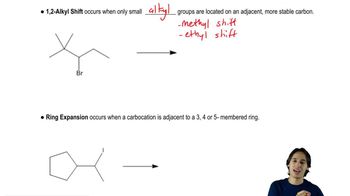
Alkyl Shift

Arene Oxides

Arene oxides are reactive intermediates formed from the oxidation of aromatic compounds. They are characterized by an epoxide-like structure where an oxygen atom is bonded to a carbon atom in the aromatic ring. Understanding the reactivity of arene oxides is crucial for predicting the outcomes of various organic reactions, including rearrangements like the NIH shift, as they can lead to different products based on the stability of the resulting structures.
추천 영상:
03:20
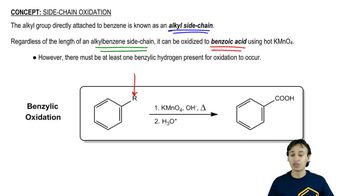
Benzylic Oxidation

Isotope Effects

Isotope effects refer to the differences in reaction rates or mechanisms that occur when isotopes of an element are substituted in a molecule. In this context, the presence of deuterium (D) instead of hydrogen (H) affects the bond strength, making C—D bonds stronger and less likely to break compared to C—H bonds. This concept is essential for predicting the major product of the NIH shift, as it influences which bond will break during the rearrangement process.
추천 영상:
03:06
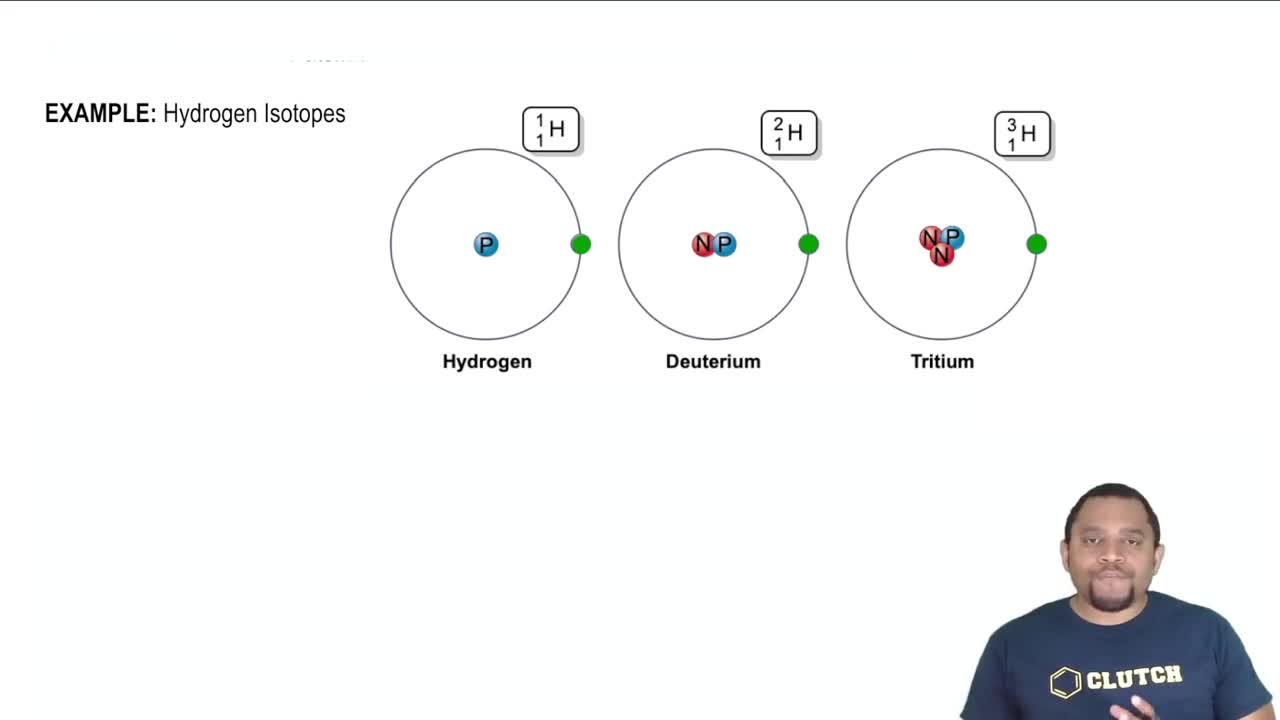
Understanding the hydrogen isotopes.