Ch. 10 - Reactions of Alcohols, Ethers, Epoxides, Amines, and Sulfur-Containing Compounds
Bruice - Organic Chemistry 8th Edition
Bruice8th EditionOrganic ChemistryISBN: 9780135213711당신이 사용하는 게 아니라요?교과서 변경
10장, 문제 61c

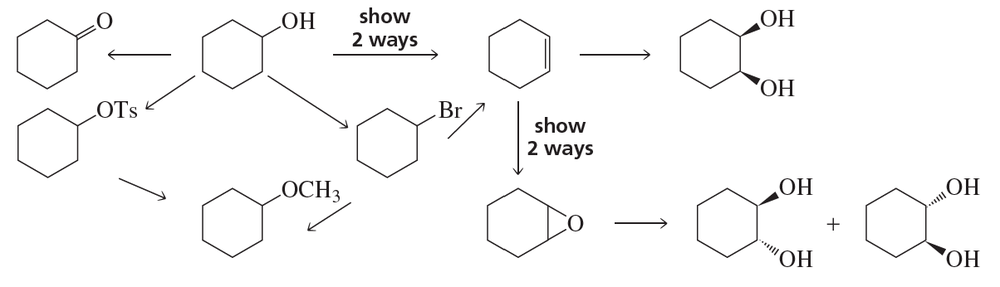
Write the appropriate reagent over each arrow.
Chemical reaction diagram illustrating various oxidizing agents with arrows indicating the appropriate reagents above each arrow.

검증된 단계별 안내
1
Step 1: Analyze the starting material, which is cyclopentanol. The hydroxyl (-OH) group is attached to a cyclopentane ring.
Step 2: Identify the product, which is cyclopentene. This indicates that the reaction involves the elimination of water (dehydration) to form a double bond.
Step 3: Recognize that the appropriate reagent for this transformation is typically an acid catalyst, such as H₂SO₄ (sulfuric acid) or H₃PO₄ (phosphoric acid), to promote dehydration.
Step 4: Note that heat is often required to drive the elimination reaction, as it helps overcome the activation energy for the formation of the alkene.
Step 5: Write the reagents over the arrow: 'A' could be H₂SO₄ or H₃PO₄, and 'B' could be heat, indicating the conditions necessary for the reaction.

비슷한 문제에 대한 검증된 영상 답변:

이 영상 해법은 위 문제에 도움이 된다고 튜터들이 추천한 것입니다.
영상 길이:
8m
도움이 되었나요?

주요 개념

질문에 올바르게 답하기 위해 반드시 이해해야 하는 핵심 개념들은 다음과 같습니다.

Dehydration Reaction

A dehydration reaction involves the removal of a water molecule from a compound, typically resulting in the formation of a double bond. In organic chemistry, this process is common when converting alcohols into alkenes. The reaction often requires heat and an acid catalyst to facilitate the elimination of water.
추천 영상:
01:23
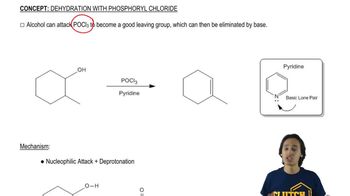
General Reaction of Dehydration with POCl3

Reagents in Organic Reactions

Reagents are substances that are added to a chemical reaction to cause a change or facilitate a reaction. In the context of dehydration of alcohols, common reagents include strong acids like sulfuric acid or phosphoric acid, which help protonate the alcohol and promote the elimination of water.
추천 영상:
02:17
Identifying organic molecules

Mechanism of Elimination Reactions

Elimination reactions, such as dehydration, typically follow a two-step mechanism: protonation of the alcohol followed by the loss of water to form a carbocation intermediate. This intermediate can then lose a proton to form a double bond, resulting in the final alkene product. Understanding this mechanism is crucial for predicting the outcome of the reaction.
추천 영상:
00:40
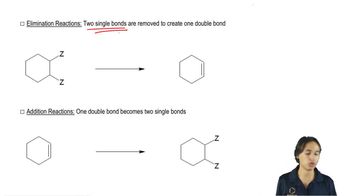
Recognizing Elimination Reactions.