Ch. 11 - Organometallic Compounds
Bruice - Organic Chemistry 8th Edition
Bruice8th EditionOrganic ChemistryISBN: 9780135213711당신이 사용하는 게 아니라요?교과서 변경
11장, 문제 30

Identify A through H
Chemical reaction diagram showing steps labeled A through H for synthesizing organic compounds.

검증된 단계별 안내
1
Step 1: Analyze the starting material, which is 1-bromopropane. The bromine atom is a good leaving group, making this molecule suitable for substitution or elimination reactions.
Step 2: Identify the first reaction (1.A and 2.B). The reagents A and B likely involve a nucleophile and a base, respectively. A substitution reaction (SN2 mechanism) could occur, replacing the bromine atom with a nucleophile to form compound C.
Step 3: Examine compound C, which appears to be propanol (an alcohol). The second reaction (1.D and 2.E) likely involves oxidation or substitution. If oxidation occurs, the alcohol group could be converted into a carbonyl group, forming an aldehyde or ketone.
Step 4: Analyze compound D, which is a longer-chain alcohol. The third reaction (1.F, 2.G, and 3.H) likely involves ether formation. This could be achieved through Williamson ether synthesis, where the alcohol reacts with an alkyl halide in the presence of a base.
Step 5: The final product is an ether, indicating that the alcohol group in compound D has been converted into an ether functional group. The reaction sequence involves substitution and elimination steps to achieve the transformation.

비슷한 문제에 대한 검증된 영상 답변:

이 영상 해법은 위 문제에 도움이 된다고 튜터들이 추천한 것입니다.
영상 길이:
7m
도움이 되었나요?

주요 개념

질문에 올바르게 답하기 위해 반드시 이해해야 하는 핵심 개념들은 다음과 같습니다.

Nucleophilic Substitution

Nucleophilic substitution is a fundamental reaction in organic chemistry where a nucleophile attacks an electrophile, resulting in the replacement of a leaving group. This process is crucial for understanding how compounds A through H are formed in the reaction sequence. The mechanism can follow either an SN1 or SN2 pathway, depending on the structure of the substrate and the conditions of the reaction.
추천 영상:
01:47
Nucleophiles and Electrophiles can react in Substitution Reactions.

Organometallic Reagents

Organometallic reagents, such as Grignard reagents, are compounds containing a carbon-metal bond, typically involving magnesium or lithium. These reagents are highly reactive and serve as nucleophiles in various organic reactions, including the formation of alcohols and other functional groups. Understanding their reactivity is essential for predicting the outcomes of the transformations depicted in the reaction diagram.
추천 영상:
02:50
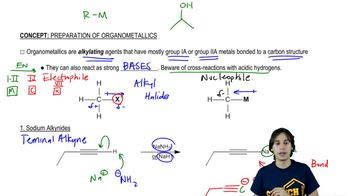
Ruining Organometallics

Functional Group Transformations

Functional group transformations involve the conversion of one functional group into another through chemical reactions. In the context of the provided reaction scheme, recognizing how different functional groups (like alcohols, ethers, and halides) are interconverted is vital for identifying compounds A through H. Mastery of these transformations allows chemists to synthesize complex molecules efficiently.
추천 영상:
02:36
Identifying Functional Groups