Ch. 11 - Organometallic Compounds
Bruice - Organic Chemistry 8th Edition
Bruice8th EditionOrganic ChemistryISBN: 9780135213711당신이 사용하는 게 아니라요?교과서 변경
11장, 문제 31f

Using the given starting material, any necessary inorganic reagents and catalysts, and any carbon-containing compounds with no more than three carbons, indicate how each of the following compounds can be prepared:
f.

검증된 단계별 안내
1
Step 1: Analyze the transformation. The starting material is ethanol (CH₃CH₂OH), and the target compound is 1-butanol (CH₃CH₂CH₂CH₂OH). This involves extending the carbon chain by two carbons.
Step 2: Convert ethanol into an ethyl halide. React ethanol with a hydrogen halide (e.g., HBr) to form ethyl bromide (CH₃CH₂Br). This is a substitution reaction where the hydroxyl group is replaced by a bromine atom.
Step 3: Prepare a Grignard reagent. React ethyl bromide (CH₃CH₂Br) with magnesium in dry ether to form ethylmagnesium bromide (CH₃CH₂MgBr). This is a key intermediate for carbon chain extension.
Step 4: React ethylmagnesium bromide with formaldehyde (HCHO). Formaldehyde is a carbon-containing compound with one carbon, which is allowed by the problem constraints. The reaction forms a primary alcohol after hydrolysis, extending the chain by one carbon to form 1-propanol (CH₃CH₂CH₂OH).
Step 5: Repeat the Grignard reaction. Convert 1-propanol into propyl bromide (CH₃CH₂CH₂Br) using HBr, then react propyl bromide with magnesium to form propylmagnesium bromide (CH₃CH₂CH₂MgBr). React this Grignard reagent with formaldehyde again, followed by hydrolysis, to form 1-butanol (CH₃CH₂CH₂CH₂OH).

비슷한 문제에 대한 검증된 영상 답변:

이 영상 해법은 위 문제에 도움이 된다고 튜터들이 추천한 것입니다.
영상 길이:
6m
도움이 되었나요?

주요 개념

질문에 올바르게 답하기 위해 반드시 이해해야 하는 핵심 개념들은 다음과 같습니다.

Organic Synthesis

Organic synthesis is the process of constructing organic compounds through chemical reactions. It involves the strategic selection of starting materials, reagents, and conditions to achieve the desired product. Understanding the principles of organic synthesis is crucial for designing pathways to create specific compounds, especially when limited to certain reagents and carbon chain lengths.
추천 영상:
가이드 코스
1:16
Synthesis of Amino Acids: Strecker Synthesis Example 1

Reagents and Catalysts

Reagents are substances used in chemical reactions to bring about a transformation, while catalysts are agents that speed up reactions without being consumed. In organic chemistry, the choice of reagents and catalysts can significantly influence the efficiency and selectivity of a synthesis. Familiarity with common inorganic reagents and catalysts is essential for planning effective synthetic routes.
추천 영상:
가이드 코스
2:10
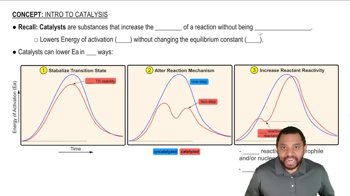
Introduction to Catalysis Concept 1

Functional Groups

Functional groups are specific groups of atoms within molecules that are responsible for the characteristic chemical reactions of those molecules. Identifying the functional groups in both the starting materials and the target compounds is vital for predicting reactivity and determining the necessary transformations. A solid understanding of functional groups aids in the design of synthetic pathways.
추천 영상:
02:36
Identifying Functional Groups