

Ch. 11 - Organometallic Compounds
Bruice - Organic Chemistry 8th Edition
Bruice8th EditionOrganic ChemistryISBN: 9780135213711당신이 사용하는 게 아니라요?교과서 변경
11장, 문제 38c

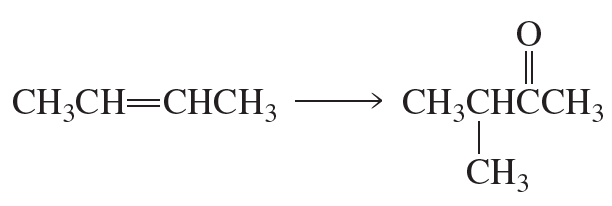
Using the given starting material, any necessary inorganic reagents and catalysts, and any carbon-containing compounds with no more than two carbons, indicate how each of the following compounds can be prepared:
c. Chemical reaction showing the conversion of butene to a carbonyl compound with structural formulas.

검증된 단계별 안내
1
Step 1: Analyze the starting material and the target compound. The starting material is an alkene (1-hexene), and the target compound is a ketone (2-hexanone). This suggests that the reaction involves oxidation of the alkene to form a ketone.
Step 2: Select the appropriate reaction pathway. To convert an alkene to a ketone, one effective method is oxidative cleavage followed by rearrangement. Ozonolysis is a common reaction for cleaving alkenes into carbonyl compounds.
Step 3: Perform ozonolysis. Treat the alkene with ozone (O₃) followed by a reducing agent such as zinc (Zn) and water (H₂O) or dimethyl sulfide (DMS). This will cleave the double bond and form the corresponding ketone.
Step 4: Verify the carbon count. Ensure that the carbon skeleton of the product matches the target compound. In this case, the ketone (2-hexanone) retains the original carbon chain of the starting material.
Step 5: Confirm the functional group transformation. The reaction successfully converts the alkene functional group into a ketone functional group, completing the synthesis of the target compound.

비슷한 문제에 대한 검증된 영상 답변:

이 영상 해법은 위 문제에 도움이 된다고 튜터들이 추천한 것입니다.
영상 길이:
4m
도움이 되었나요?

주요 개념

질문에 올바르게 답하기 위해 반드시 이해해야 하는 핵심 개념들은 다음과 같습니다.

Organometallic Reagents

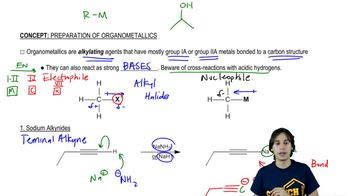
Organometallic reagents are compounds that contain a carbon-metal bond, where the carbon is part of an organic group. These reagents are crucial in organic synthesis as they can act as nucleophiles, allowing for the formation of new carbon-carbon bonds. Common examples include Grignard reagents and organolithium compounds, which can react with various electrophiles to create complex organic molecules.
추천 영상:
02:50
Ruining Organometallics

Nucleophilic Addition Reactions

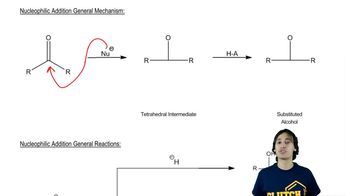
Nucleophilic addition reactions involve the attack of a nucleophile on an electrophilic center, typically a carbon atom with a partial positive charge. This type of reaction is fundamental in organic chemistry, particularly in the formation of alcohols, amines, and other functional groups. Understanding the mechanism of nucleophilic addition is essential for predicting the outcomes of reactions involving carbonyl compounds and other electrophiles.
추천 영상:
08:27
Nucleophilic Addition

Stereochemistry

Stereochemistry is the study of the spatial arrangement of atoms in molecules and how this affects their chemical behavior. In organic synthesis, the stereochemical configuration of products can significantly influence their reactivity and biological activity. Recognizing the importance of stereochemistry is vital when designing synthesis pathways, especially when dealing with chiral centers and the potential for stereoisomer formation.
추천 영상:
가이드 코스
1:38
Polymer Stereochemistry Concept 1