Ch. 12 - Radicals
Bruice - Organic Chemistry 8th Edition
Bruice8th EditionOrganic ChemistryISBN: 9780135213711당신이 사용하는 게 아니라요?교과서 변경
12장, 문제 9a

Would chlorination or bromination produce a greater yield of 1-halo-2,3-dimethylbutane?

검증된 단계별 안내
1
Understand the difference between chlorination and bromination: Chlorination is less selective but faster, while bromination is more selective but slower. This difference in selectivity will influence the yield of the desired product.
Analyze the structure of 1-halo-2,3-dimethylbutane: The molecule has multiple types of hydrogen atoms (primary, secondary, and tertiary). Bromination tends to favor the formation of the most stable radical intermediate, which is typically a tertiary radical.
Determine the likely radical intermediates: In the case of 2,3-dimethylbutane, bromination will preferentially abstract a hydrogen from the tertiary carbon (if present), leading to a higher yield of the desired product. Chlorination, being less selective, may abstract hydrogens from primary, secondary, or tertiary carbons, leading to a mixture of products.
Compare the yields: Bromination will produce a greater yield of 1-halo-2,3-dimethylbutane because it selectively forms the product via the most stable radical intermediate. Chlorination, due to its lower selectivity, will result in a lower yield of the desired product and more byproducts.
Conclude: Bromination is the better choice for producing a higher yield of 1-halo-2,3-dimethylbutane due to its higher selectivity for the most stable radical intermediate.

비슷한 문제에 대한 검증된 영상 답변:

이 영상 해법은 위 문제에 도움이 된다고 튜터들이 추천한 것입니다.
영상 길이:
4m

주요 개념

질문에 올바르게 답하기 위해 반드시 이해해야 하는 핵심 개념들은 다음과 같습니다.

Halogenation

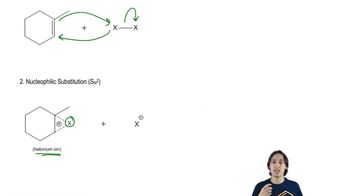
Halogenation is a chemical reaction that involves the substitution of hydrogen atoms in an organic compound with halogen atoms (such as chlorine or bromine). The process can lead to the formation of haloalkanes, and the reactivity of the halogen plays a crucial role in determining the yield of the desired product. Understanding the mechanism of halogenation, including radical formation and stability, is essential for predicting the outcome of the reaction.
추천 영상:
03:45
Halogenation Mechanism

Radical Stability

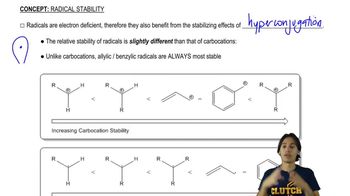
The stability of radicals formed during halogenation significantly influences the reaction's selectivity and yield. Tertiary radicals are more stable than secondary or primary radicals due to hyperconjugation and inductive effects. In the case of 1-halo-2,3-dimethylbutane, the formation of more stable radicals will favor the reaction pathway that leads to a higher yield of the desired haloalkane.
추천 영상:
03:43
The radical stability trend.

Selectivity of Halogens

Chlorination and bromination exhibit different selectivities due to their distinct reactivity. Bromination is generally more selective than chlorination, leading to fewer by-products and a higher yield of the desired product. This selectivity arises from the differences in bond dissociation energies and the stability of the transition states involved in the reactions, making bromination preferable for producing specific haloalkanes like 1-halo-2,3-dimethylbutane.
추천 영상:
03:45
Halogenation Mechanism