Ch. 12 - Radicals
Bruice - Organic Chemistry 8th Edition
Bruice8th EditionOrganic ChemistryISBN: 9780135213711당신이 사용하는 게 아니라요?교과서 변경
12장, 문제 1

Write the initiation, propagation, and termination steps for the monochlorination of cyclohexane.

검증된 단계별 안내
1
Write the initiation step: In this step, the chlorine molecule (Cl₂) undergoes homolytic cleavage under the influence of UV light or heat to form two chlorine radicals. Represent this as: Cl₂ → 2Cl•.
Write the first propagation step: A chlorine radical (Cl•) reacts with cyclohexane (C₆H₁₂), abstracting a hydrogen atom to form hydrogen chloride (HCl) and a cyclohexyl radical (C₆H₁₁•). Represent this as: Cl• + C₆H₁₂ → HCl + C₆H₁₁•.
Write the second propagation step: The cyclohexyl radical (C₆H₁₁•) reacts with another chlorine molecule (Cl₂), forming chlorocyclohexane (C₆H₁₁Cl) and regenerating a chlorine radical (Cl•). Represent this as: C₆H₁₁• + Cl₂ → C₆H₁₁Cl + Cl•.
Write the termination steps: Termination occurs when two radicals combine to form a stable molecule. Examples include: (1) Cl• + Cl• → Cl₂, (2) C₆H₁₁• + Cl• → C₆H₁₁Cl, and (3) C₆H₁₁• + C₆H₁₁• → C₆H₁₁-C₆H₁₁.
Ensure the overall reaction is balanced: Combine the initiation, propagation, and termination steps to confirm that the overall reaction is the substitution of one hydrogen atom in cyclohexane with a chlorine atom, forming chlorocyclohexane and HCl.

비슷한 문제에 대한 검증된 영상 답변:

이 영상 해법은 위 문제에 도움이 된다고 튜터들이 추천한 것입니다.
영상 길이:
3m
도움이 되었나요?

주요 개념

질문에 올바르게 답하기 위해 반드시 이해해야 하는 핵심 개념들은 다음과 같습니다.

Free Radical Halogenation

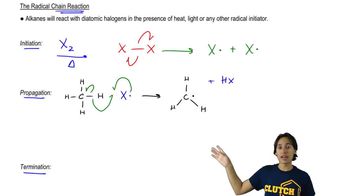
Free radical halogenation is a reaction mechanism where alkanes react with halogens to form alkyl halides. This process involves the generation of free radicals, which are highly reactive species with unpaired electrons. The reaction typically occurs in three stages: initiation, propagation, and termination, each playing a crucial role in the overall mechanism.
추천 영상:
가이드 코스
12:11
Radical Chain Reaction Mechanism.

Initiation Step

The initiation step involves the formation of free radicals from halogen molecules, usually through the application of heat or light. For monochlorination of cyclohexane, chlorine molecules (Cl2) dissociate into two chlorine radicals (Cl•), which are essential for starting the reaction. This step is critical as it sets the stage for the subsequent propagation steps.
추천 영상:
1:05
Step-Growth Polymers Concept 1

Propagation and Termination Steps

Propagation steps involve the reaction of the generated radicals with cyclohexane, leading to the formation of new radicals and the desired product, chlorocyclohexane. This cycle continues until the radicals are consumed. The termination step occurs when two radicals combine to form a stable molecule, effectively stopping the reaction. Understanding these steps is vital for predicting the products and yields of the reaction.
추천 영상:
1:05
Step-Growth Polymers Concept 1