Ch. 13 - Mass Spectrometry; Infrared Spectroscopy; UV/Vis Spectroscopy
Bruice - Organic Chemistry 8th Edition
Bruice8th EditionOrganic ChemistryISBN: 9780135213711당신이 사용하는 게 아니라요?교과서 변경
13장, 문제 47

Assuming that the force constant is approximately the same for C–C, C–N, and C–O bonds, predict the relative positions of their stretching vibrations in an IR spectrum.

검증된 단계별 안내
1
Understand the relationship between bond strength, reduced mass, and vibrational frequency. The vibrational frequency (ν) of a bond in IR spectroscopy is given by the equation: ν = kμ, where k is the force constant (bond strength) and μ is the reduced mass of the bonded atoms.
Since the problem states that the force constant (k) is approximately the same for C-C, C-N, and C-O bonds, the vibrational frequency will primarily depend on the reduced mass (μ).
Calculate the reduced mass for each bond. The reduced mass is given by the formula: μ = m1m2/(m1 + m2), where m1 and m2 are the atomic masses of the two bonded atoms. For C-C, C-N, and C-O bonds, use the atomic masses of carbon (12 amu), nitrogen (14 amu), and oxygen (16 amu).
Compare the reduced masses. A smaller reduced mass corresponds to a higher vibrational frequency, as the frequency is inversely proportional to the square root of the reduced mass (ν1μ).
Based on the reduced masses, predict the relative positions of the stretching vibrations in the IR spectrum. The bond with the smallest reduced mass (C-H) will have the highest frequency, followed by C-N, and then C-O, which will have the lowest frequency.

비슷한 문제에 대한 검증된 영상 답변:

이 영상 해법은 위 문제에 도움이 된다고 튜터들이 추천한 것입니다.
영상 길이:
5m

주요 개념

질문에 올바르게 답하기 위해 반드시 이해해야 하는 핵심 개념들은 다음과 같습니다.

Bond Strength and Vibrational Frequency

The strength of a bond influences its vibrational frequency in infrared (IR) spectroscopy. Stronger bonds typically vibrate at higher frequencies due to the greater force required to stretch them. In this context, C-C, C-N, and C-O bonds will have different strengths, affecting their positions in the IR spectrum.
추천 영상:
06:00
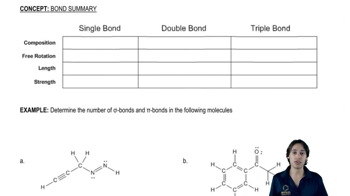
Single bonds, double bonds, and triple bonds.

Electronegativity and Bond Character

Electronegativity refers to the ability of an atom to attract electrons in a bond. In the case of C-O and C-N bonds, oxygen is more electronegative than nitrogen, leading to a polar bond character. This polarity can influence the bond strength and, consequently, the vibrational frequency observed in the IR spectrum.
추천 영상:
1:47
Electronegativity

IR Spectroscopy and Functional Groups

Infrared (IR) spectroscopy is a technique used to identify functional groups in organic compounds based on their characteristic absorption of infrared light. Each functional group has a specific range of stretching vibrations, allowing chemists to predict the positions of peaks in an IR spectrum based on the types of bonds present in the molecule.
추천 영상:
02:36
Identifying Functional Groups