
Ch. 17 - Reactions at the Alpha-Carbon
Bruice - Organic Chemistry 8th Edition
Bruice8th EditionOrganic ChemistryISBN: 9780135213711당신이 사용하는 게 아니라요?교과서 변경
17장, 문제 79

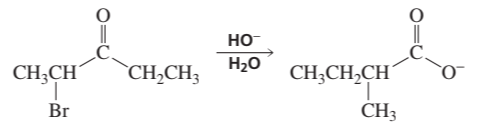
A carboxylic acid is formed when an a-haloketone reacts with hydroxide ion. This reaction is called a Favorskii reaction. Propose a mechanism for the following Favorskii reaction. (Hint: In the first step, HO- removes a proton from the a-carbon that is not bonded to Br; a three-membered ring is formed in the second step; and HO- is a nucleophile in the third step.)
Favorskii reaction mechanism showing a-haloketone converting to a carboxylic acid with hydroxide ion.

검증된 단계별 안내
1
Step 1: The hydroxide ion (HO⁻) acts as a base and removes a proton from the α-carbon that is not bonded to the bromine atom. This deprotonation generates a carbanion intermediate at the α-carbon.
Step 2: The carbanion intermediate undergoes intramolecular nucleophilic attack on the carbonyl carbon, forming a three-membered cyclic intermediate known as a cyclopropanone.
Step 3: The bromine atom is expelled from the cyclopropanone intermediate, resulting in the formation of a new carbanion at the α-carbon adjacent to the carbonyl group.
Step 4: The hydroxide ion (HO⁻) acts as a nucleophile and attacks the carbonyl carbon of the intermediate, leading to the opening of the three-membered ring and formation of a tetrahedral intermediate.
Step 5: The tetrahedral intermediate undergoes proton transfer, resulting in the formation of the carboxylic acid product with the hydroxide ion regenerating as the leaving group.

비슷한 문제에 대한 검증된 영상 답변:

이 영상 해법은 위 문제에 도움이 된다고 튜터들이 추천한 것입니다.
영상 길이:
6m

주요 개념

질문에 올바르게 답하기 위해 반드시 이해해야 하는 핵심 개념들은 다음과 같습니다.

Favorskii Reaction

The Favorskii reaction is a rearrangement reaction involving α-haloketones that leads to the formation of carboxylic acids. In this reaction, a hydroxide ion (HO-) acts as a base and nucleophile, facilitating the conversion of the α-haloketone into a carboxylic acid through a series of steps, including deprotonation and ring formation.
추천 영상:
05:09
Heck Reaction

Nucleophilic Attack

Nucleophilic attack is a fundamental concept in organic chemistry where a nucleophile, which is an electron-rich species, attacks an electron-deficient center, typically a carbon atom in a carbonyl group. In the Favorskii reaction, the hydroxide ion acts as a nucleophile, attacking the electrophilic carbon in the three-membered ring formed during the reaction, leading to the final product.
추천 영상:
08:27
Nucleophilic Addition

Three-Membered Ring Formation

The formation of a three-membered ring, often referred to as an epoxide or cyclic intermediate, is a key step in many organic reactions, including the Favorskii reaction. This intermediate is formed when a nucleophile attacks an electrophilic carbon, resulting in a cyclic structure that can stabilize the transition state and facilitate further reactions, ultimately leading to the desired product.
추천 영상:
05:14
Ring Expansion