

Ch. 17 - Reactions at the Alpha-Carbon
Bruice - Organic Chemistry 8th Edition
Bruice8th EditionOrganic ChemistryISBN: 9780135213711당신이 사용하는 게 아니라요?교과서 변경
17장, 문제 89b

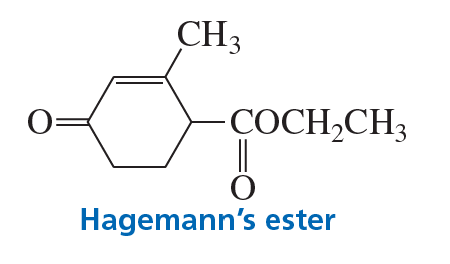
A compound known as Hagemann's ester can be prepared by treating a mixture of formaldehyde and ethyl acetoacetate first with base and then with acid and heat. Write the structure for the product of each of the steps.
b. The second step is a Michael addition.
Chemical structure of Hagemann's ester, featuring a benzene ring, carbonyl, and ethyl acetoacetate groups.

검증된 단계별 안내
1
Step 1: Understand the reaction sequence. The problem involves the preparation of Hagemann's ester, which includes multiple steps: (1) base-catalyzed reaction, (2) Michael addition, and (3) acid-catalyzed cyclization and dehydration. Focus on the second step, which is the Michael addition.
Step 2: Recall the Michael addition mechanism. This is a conjugate addition reaction where a nucleophile (in this case, the enolate ion formed from ethyl acetoacetate) adds to an α,β-unsaturated carbonyl compound (in this case, the product formed from formaldehyde and ethyl acetoacetate in the first step).
Step 3: Identify the nucleophile and electrophile. The enolate ion acts as the nucleophile, and the α,β-unsaturated carbonyl compound acts as the electrophile. The nucleophile attacks the β-carbon of the electrophile, forming a new carbon-carbon bond.
Step 4: Write the intermediate structure. After the nucleophilic attack, a new intermediate is formed. This intermediate contains a new single bond between the β-carbon of the electrophile and the α-carbon of the nucleophile, along with a stabilized enolate or keto form.
Step 5: Prepare for the next step. The intermediate formed in the Michael addition will undergo further reaction in the third step (acid-catalyzed cyclization and dehydration) to yield the final product, Hagemann's ester.

비슷한 문제에 대한 검증된 영상 답변:

이 영상 해법은 위 문제에 도움이 된다고 튜터들이 추천한 것입니다.

주요 개념

질문에 올바르게 답하기 위해 반드시 이해해야 하는 핵심 개념들은 다음과 같습니다.

Hagemann's Ester

Hagemann's ester is a compound formed through a reaction involving formaldehyde and ethyl acetoacetate. This reaction typically involves a base-catalyzed step followed by an acid-catalyzed step, leading to the formation of a β-keto ester. Understanding the structure and reactivity of Hagemann's ester is crucial for predicting the outcomes of subsequent reactions.
추천 영상:
02:39
Ester Nomenclature

Michael Addition

The Michael addition is a nucleophilic addition reaction where a nucleophile adds to an α,β-unsaturated carbonyl compound. In this context, the nucleophile is often a carbanion or another reactive species that attacks the β-carbon of the unsaturated system. This step is essential in the synthesis of complex molecules, as it forms new carbon-carbon bonds and contributes to the overall molecular architecture.
추천 영상:
09:23
1,2 vs 1,4 Addition

Reaction Mechanism

A reaction mechanism describes the step-by-step process by which reactants are converted into products. It includes details about the intermediates formed, the transition states, and the energy changes throughout the reaction. Understanding the mechanism of the Hagemann's ester formation and the subsequent Michael addition is vital for predicting the structure of the final product and the conditions required for each step.
추천 영상:
02:16
Heck Reaction Mechanism